The Curse of the Honest Vice-President and the Evolving President

“EEEK! The President is EVOLVING!!!”

Vice-President Joe Biden sent Washington, D.C.’s pundits into a tizzy when he told  NBC’s “Meet the Press” last Sunday that he was“absolutely comfortable” with same-sex marriage. It is amazing, when Biden has lapped all previous Vice Presidents in goofs, mistakes, outrageous statements and embarrassments that this statement—honest, reasonable and forthright—should be regarded as a serious blunder. What did he do wrong this time? As Dana Milbank of the Washington Post put it, Biden “committing the classic Washington gaffe of accidentally speaking the truth.”

And why is it a gaffe for this Vice President to tell the truth by stating his support for a position strongly favored by the majority of Democrats, and increasingly the public as a whole? Why would Biden be off message by embracing a core cause of the gay, lesbian and transgendered community, which is overwhelmingly in the Obama camp? The answer is that he has embarrassed the President by calling attention to the fact that President Obama has conspicuously avoided making such a clear and unequivocal statement on the issue, because he wants to avoid being open, honest, direct and truthful about his views on gay marriage until after the election. Continue reading →

Estate Tax Ethics

This was not my father. For one thing, he was shorter.

My sister and I finally settled up the estate of our parents after over a year of paper signing, meetings with accountants, and mind-numbing calculations. The estate, as my folks wanted it, was divided 35%-35%-30%, with the last portion going into a trust for the three grandchildren. The amount of money in the estate was a shock to my sister and me, and a very pleasant surprise, though for all the problems the money will solve, we would have forfeited all of it to have Mom and Dad alive today. Still, being able to give over substantial assets to their children and grandchildren was one of their lifelong goals, and they would have been satisfied and proud that they succeeded so spectacularly.

My sister, a good, reliable liberal, asked me whether I felt guilty about the inheritance. I said yes, in the sense that I wish our parents hadn’t been so resolutely frugal in their retirement, and had spent more of the money they earned and saved on more of their own pleasure and enjoyment rather than squirreling it away for us. But did I feel any pangs of conscience because the money wasn’t going to Uncle Sam’s coffers?

Absolutely not. Continue reading →

Ethics Article of the Week: George Will On His Son’s Birthday

Happy birthday, Jon.

Conservative columnist George Will has only occasionally mentioned his Down Syndrome-inflicted son Jon in his columns, but when he has, it has provided an extra dimension to Jon’s father, who usually comes across in print and on TV as cynical, dour, and archly intellectual. Today is Jon’s birthday, so Will devotes the full column to him, his challenges, and, when all is said and done, ethics.

It’s a beautifully written piece, as Will’s columns often are, and a tender one. More importantly, however, it is an essay that should provoke thought, beginning with the fact that the only reason Will wrote this column is that he and his wife chose, 40 years ago, to do what 90% of all parents informed that their gestating child has Down Syndrome refuse to do: allow the child to be born.

The column is here

__________________________________________________

Graphics: Richmond Times-Dispatch

Now THIS Is Unprofessional Conduct: The Lesson of the Jilted Dentist

No! It's NOT safe! It's not safe at ALL!

The hallmark of professionals is trust. We should be able to trust professionals to do their duty on our behalf despite their personal feelings. Lawyers often dislike or even fear their clients, for example: a defendant charged with murder who has stabbed his previous three attorneys with pencils is now back in court with a fourth, though certain precautions have been taken. When a professional finds that his or her personal feelings are so intense that they jeopardize the professional’s ability to fulfill their duties objectively, fairly and well, then that’s a conflict of interest, and it must be dealt with, usually by stepping aside.

A professional who doesn’t step aside despite an evident conflict has determined that he or she has the detachment and self-control to overcome it. A recent news story from Poland, however, suggests that it is not a good idea to risk too much trust on a professional’s determination that she can remain objective. Continue reading →

Weekend Ethics Catch-Up

If you took an ethics break this last weekend of February, here’s your Ethics Alarms make-up assignment:


America Is Severely Confused About Domestic Abuse

John Wayne paddling his wife (Maureen O'Hara) in "McClintock!" I love ya, Duke, but this isn't funny any more....if it ever was.

Violence inflicted by one partner in a relationship upon another is absolutely unethical, yet it is one of those embedded cultural habits from the bad old days that still flourishes. Over at the Whitney Houston post, where I am being over-run by the drug-legalization zealots, sicced on me by a sad website where people indulge their dreams of legally de-braining themselves on a regular basis, there is widespread contempt for the concept  that cultural norms of what is right, wrong and worthy of shame controls our worst impulses. That contempt is as crippling as it is ignorant, for controlling behavior is what cultures do, and why they are essential. And our culture is still giving confusing signals about domestic abuse. Two recent examples: Continue reading →

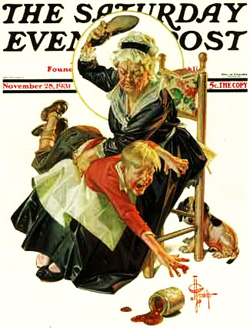
The Ethics of Corporal Punishment For Children

Spare the rod, and avoid a restraining order...

The societal approval pendulum has swung so far away from physically punishing children that a formal spanking risks an accusation of child abuse. The Hawaii Supreme Court, in the case of Hamilton ex rel. Lethem v. Lethem,  in which a retraining order was issued against a father accused of abusing his 15-year-old daughter, pronounced guidelines for determining what constitutes reasonable and moderate corporal punishment of a child by a parent, ruling that such punishment is reasonable (and a Constitutional right ) when..

  • “…the parent’s discipline is reasonably related to the purpose of safeguarding or promoting the welfare of the minor,”
  • The punishment properly takes into account the nature of the misbehavior,
  •  …the child’s age and size, and
  • …the nature and propriety of the force used. Continue reading →

The Marianne Gingrich Ethics Train Wreck

Ugh. What a mess.

The ethics miscreants:

Marianne Gingrich: Seething with hate for Newt, she decided to try to metaphorically stick a shiv in his back by airing dirty laundry from their marriage right before the South Carolina primary, a do-or-die for him. Her interview with ABC was unfair and an act of pure revenge. You couldn’t call it whistle-blowing, since anyone who doesn’t already know what a likely sociopath Gingrich is has been watching too many re-runs of “NCIS.” Gingrich’s character, or lack of it, was established and in the books by 1998. Marianne should have not had to say a word, but everything she did say, she had said before, in an interview in 2010 in Esquire. Continue reading →

“Ask Amy” Tackles A Classic—And Misses

Advice columnist Amy (of the syndicated column “Ask Amy”), was just asked one of those questions that every advice maven has to have in their files, with the perfect answer ready to go. If Amy had her answer prepared, it was  the wrong one.

The question was the deathless classic, “I just found out my husband has been having an affair with a married co-worker. Should I tell the other spouse?”

Amy gets it half right: she tells the reader that the other spouse has a right to know; that this is not a case of meddling because the reader is directly involved in the betrayal; and that not to make sure the other spouse learns the truth would now be abetting the deception. All true. BUT…

…Amy forgets the Golden Rule as it applies to the reader’s husband’s adulterous lover (yes, the rule still applies to busted wrongdoers) and the whistleblowers obligation to minimize needless harm. She tells the victimized wife to spill the beans to the victimized husband.

Wrong.

The adulterous wife deserves the opportunity to tell her husband herself. That would allow her to reveal the affair to her spouse with the least damage to the marriage, and providing that opportunity to her is kind and fair. Amy should have told her reader to contact her husband’s paramour and say this: “I will be calling your husband and telling him about your relationship with my husband in three days. You should tell him the truth yourself, and then all he needs to say to me when I call is, ‘Yes, she told me.’ But if you haven’t told him, he’ll hear it all from me.”

File it away, Amy, and get it right the next time.

Love Your Lawyer? Bad Idea. Love Your Client? Even Worse.

This is all your fault, Arnie!

A Connecticut lawyer under fire for commencing a lawyer-client relationship with a woman with whom he was romantically involved made the novel argument that it is good to be in love with your client.  This indicates a profound misunderstanding of human nature and the nature of a lawyer’s duties.

Almost ten years ago, the American Bar Association recommended that state bars include a direct prohibition against lawyers having sexual relations with their clients, and the majority of the states did so. As I have mentioned before, it’s a dumb rule, too broad and too narrow simultaneously, a classic example of how some kinds of unethical conduct do not lend themselves to precise rule-making.  The main problem with the no-sex rules is that they are unnecessary. The legal ethics rules are replete with exhortations to maintain objectivity, independent judgment and to avoid conflicts of interest. Common sense suggests that it is irresponsible to confuse one relationship by adding another; professional standards dictate that combining a professional relationship of independence and with romantic relationships is wrong.  As the D.C. Bar’s Rules of Professional Conduct point out in its comments to Rule 1.7, Conflicts of Interest: Continue reading →