Here is what Al Gore might call an “inconvenient truth,” except that this really is truth, while Al’s was propaganda: there is no valid reason for any responsible parent to entrust the mind and future of a child with the kinds of teachers, administrators and “experts” currently being produced by the U.S. education sector.
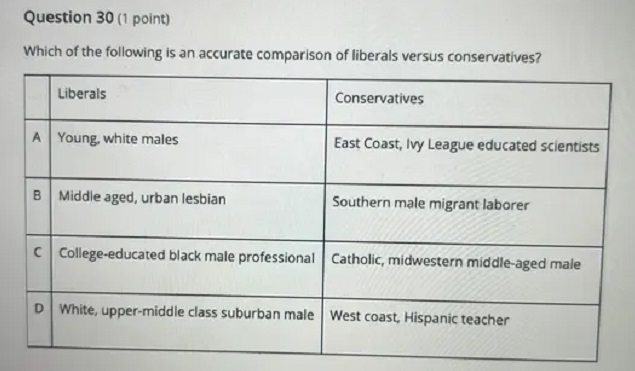
What you see above is one more piece of damning evidence.It is a recent test question in an advanced placement (AP) government course in Fairfax County, Virginia’s largest school district, one of the largest in the country, and just a short drive from my home. The question challenged students to choose an “accurate comparison of liberals versus conservatives,” giving them multiple choices.
It sure stumped me. After all, the difference between liberals and conservatives lie in belief systems and ideological orientation, not occupations and demographic categories. However, this basic fact appears to have escaped the creators of the question. (The “correct” answer, at least according to the dimwits who devised the thing, is “C.”)

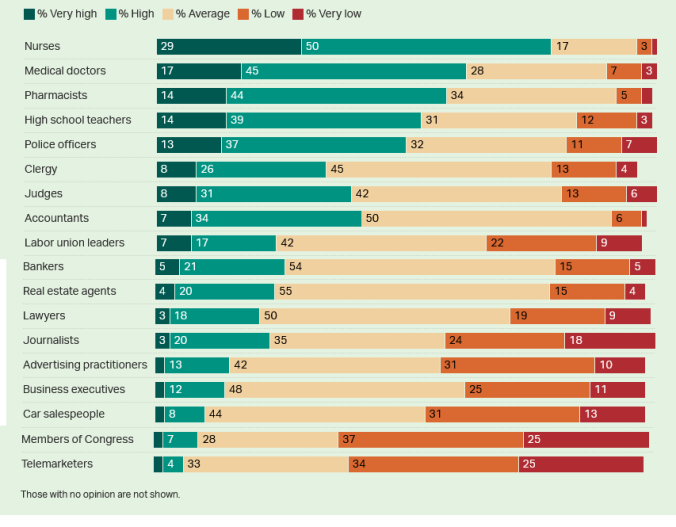 Those polled were asked, “





I dabbled in journalism as an undergrad. Admittedly, that wasn’t exactly last week: the newsroom was stocked with manual typewriters, if that gives you a rough idea. There was no journalism department, and, I believe, only a single introductory course–which virtually no one on the staff of the newspaper took. A bunch of my colleagues turned out okay, though: three that I worked with ended up in senior management positions: one with the Wall Street Journal, one with the International Herald Tribune, one with Newsweek.
I did some day editing, mostly on the arts page; I had a weekly column, and I did a little news reporting. I never sought an upper-level editorial position. It’s possible, perhaps even probable, I could have been arts editor if I’d really wanted the job; I didn’t.
But I did have a lot of conversations about journalism with some people who were subsequently to be very successful in that business. The consensus was that objectivity was a goal, but one it was impossible to achieve. The reasons for this were two-fold. First, you can’t entirely suppress your own life experience, perspectives, and (yes) prejudices. Second, you inevitably interpret the significance of events. If X happened and Y also happened, there are manifold ways of framing the story, using variations on the theme of “despite” or “therefore,” for example. Even saying “X and Y” instead of “Y and X” often betrays a bias.
Continue reading →