1. Where “Ick” and unethical become indistinguishable...Airlines have enough problems without having to deal with…this. A message was sent through the Aircraft Communications Addressing and Reporting System (ACARS) alerting a Delta crew in Atlanta that a passenger in seat 13A was “breastfeeding a cat and will not put cat back in its carrier when [flight attendant] requested.” And she was. Every time the passenger was asked to cease and desist, she attached the cat, which was of the hairless variety, not that it’s relevant, to her nipple again. A flight attendant on board during the incident, wrote on social media,
“This woman had one of those, like, hairless cats swaddled up in a blanket so it looked like a baby,” she said. “Her shirt was up and she was trying to get the cat to latch and she wouldn’t put the cat back in the carrier. And the cat was screaming for its life.”
2. A you have probably heard by now, CNN canned Chris Cuomo. This is a classic example of doing the right thing for the wrong reason: Cuomo should have been fired because he’s a terrible, unethical, none-too-bright journalist. The fact that he also mishandled a conflict of interest, abused his sources and used his position with CNN to assist his brother as The Luv Guv tried to avoid accountability for sexual misconduct all flowed from CC’s incompetence and ethical dunderheadedness. A serious scandal of some kind involving “Fredo” was inevitable.
Chris’s scandal may be more embarrassing, but Andrew’s latest problem may be more expensive.
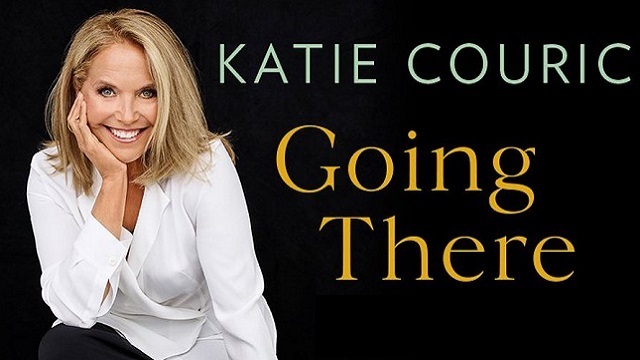
In July 2020, then-New York Governor Cuomo, riding high in the public eye, asked the state ethics panel for permission to write a book about his leadership during the pandemic.
I must interject here that such books are virtually always unethical, often in multiple ways. I say “virtually” because there really may be some instance, buried deeply in the sands of time, when a book written while a popular elected official (or a First Lady) was in office and published with that official’s name as the author was really written by the official in his or her spare time, wasn’t just a government-funded campaign and propaganda tool, and also didn’t provide a way for supporters both individual and corporate to launder contributions. Maybe, but I doubt it.
For one thing, if an elected official spends any time at all writing a book during his or her work day, he or she is getting paid by taxpayers to do work that primarily benefits the official. Books are hard. Books take time. Trust me on this, I’ve co-written one, and would have five more (I have the titles and outlines!) out there if I could get out of my own way. But my time is my own: I don’t bill clients for writing this blog, and any time I spend writing a book is time I don’t get paid for. Governors, like Presidents, are paid to be on-duty every waking hour.
Transcripts released yesterday revealed that CNN host and beefcake star Chris Cuomo actively worked with his brother’s aides to defend then Gov. Andrew Cuomo from the many sexual harassment accusers whose accounts eventually forced the Governor to resign. Chris Cuomo. aka. “Fredo,” had looked in America’s face—you know, like Bill Clinton when he said he never has sex with “that woman”—in August and assured it that he ‘never made calls to the press” on behalf of his brother. But New York Attorney General Letitia James’ report revealed texts where Chris told aide Melissa DeRosa he would take up the allegations with his “sources,” and offered to help draft statements for his brother’s team. Cuomo used his CNN contacts dig up information about his brothers’ his accusers, presumably to discredit them. Another revelation in James’ documents was that Cuomo was working through a friend to approach actor Alec Baldwin about making a video defending Andrew.
In summary, Chris Cuomo used his contacts, sources and influence as a CNN journalist to actively assist an elected official, indeed to assist an official in avoiding the consequences of illegal acts. This is, duh, wildly unethical, unprofessional, and a breach of trust with both CNN and the public. Apparently it is even so unethical that other unethical journalists of the Left, who are usually hesitant to throw stones at fellow propagandists and fake news purveyors from inside their glass houses, have pointed their fingers at poor Chris like pod people identifying their next target for assimilation.
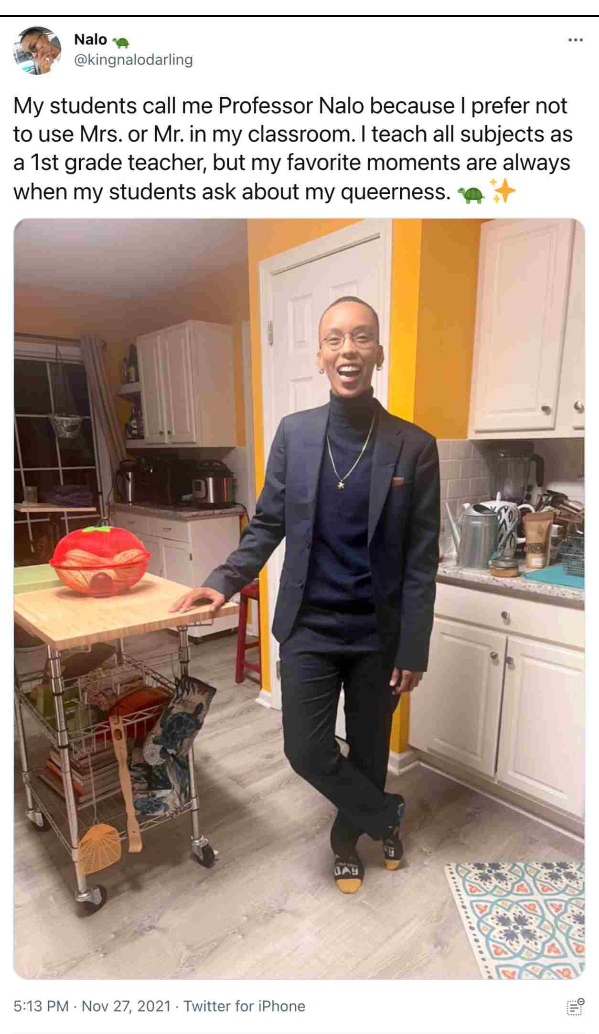
What’s the ethical way to deal with “Professor Nalo”?
(Or is there one?)
Stipulated: a grade school teacher’s sexual orientation, identity, habits and proclivities are not a proper topic for instruction or discussion with students. Prof. Nalo also raises the question of whether it is competent or responsible for a school to hire a screaming narcissist as a teacher at any level.
[Full disclosure: One of my favorite teachers growing up was, in fact, a screaming narcissist, though I didn’t realize it at the time. But boy, did she do a lot of damage to some of my classmates.]
November 29 marks the anniversary of the world making a firm choice in a position of ethics zugszwang, as the United Nations voted in 1947 to partition Palestine and create an independent Jewish state. Things have never been peaceful or, apparently, resolvable since. Jews and Arabs had been arguing over the region since the first decade of the 20th Century, as both groups wanted the British-controlled territory. The Jews had come from Europe and Russia establish a Jewish state in their ancient homeland. The native Palestinian Arabs wanted to stop Jewish immigration and set up a secular Palestinian state. In 1929, violence between Arabs and Jews broke out, and Great Britain attempted to limit Jewish immigration to appease the Arabs. The Holocaust spurred many Jews to entered Palestine anyway, however illegally, and in the 40s the Jews were the terrorists, attacking British forces in Palestine. When the U.S. sided with the Zionists in 1945, Great Britain gave up and handed its dilemma over to the United Nation, which on November 29, 1947, voted to partition Palestine.
The Jews got more than half of Palestine, despite constituting less than half of the population. The Palestinian Arabs fought the newly empowered occupants, but the Jews prevailed, not only securing their U.N.-granted share of Palestine but some of the Arab portion as well. On May 14, 1948, the State of Israel declared its official existence, and the the next day, Egypt, Jordan, Syria, Lebanon and Iraq attacked. They chose…poorly. The Israelis again prevailed, and again expanded their territories at Arab expense, taking Galilee, the Palestinian coast, and a strip of territory connecting the coastal region to the western section of Jerusalem. The Palestinians have never abandoned their goal of eliminating the Jewish state, and after so many decades, the chances of a peaceful and permanent resolution of this hundred-year-old ethics train wreck are approximately zero.
Meanwhile, Happy Hanukkah, and remember the Maccabees!
1. Note from The Great Stupid. In a new holiday-themed Peloton commercial, a modern Scrooge discovers his best self by peddling away. Awakening, he rushes to the window, just like in the Dickens tale, and shouts to the juvenile in the street, “What day is it, child?” Child? Everybody knows that the line is “What day is it, boy?” Ah! But because all commercials and casts must have a requisite number of black actors, the lad was black, and even Scrooge can’t call a black individual boy, even if he is a boy. So the “Christmas Carol” parody, which is the whole point, is knee-capped for political correctness. This director’s advice: either be bold and cast a white kid to play the white kid in the story, or ditch the concept entirely. Or…
…cast two white actors in a two-character TV ad. Now that would be revolutionary!
2. Did I miss Hillary Clinton taking over the Salvation Army? The Salvation Army’s solution to being called on it’s CRT embrace: deny, deny, deny. Also: lie. Indignantly!
As Ethics Alarms noted a few days ago, two internal Salvation Army documents, a guidebook titled “Let’s Talk About Racism” and another called the “Study Guide on Racism” fully endorse the “anti-racism” pro anti-white racism theme. “In the absence of making anti-racist choices, we (un) consciously uphold aspects of White supremacy, White-dominant culture, and unequal institutions and society,” the first document states—you know, like casting a black kid as Scrooge’s new friend. From the latter: White people are guilty “unconscious bias” and “unwittingly perpetuate racial division…We must stop denying the existence of individual and systemic/institutional racism. They exist, and are still at work to keep White Americans in power.”
I feel “Bite me!” rising up my gorge into my mouth even as I type that.
The Salvation Army is shocked—shocked!—that anyone would think it’s playing race games. In a perfect Jumbo, the group responded, “Critical Race Theory? What Critical Race Theory?”
“…[S]ome individuals and groups have recently attempted to mislabel our organization to serve their own agendas. They have claimed that we believe our donors should apologize for their skin color, that The Salvation Army believes America is an inherently racist society, and that we have abandoned our Christian faith for one ideology or another. Those claims are simply false, and they distort the very goal of our work….” The Salvation Army occasionally publishes internal study guides on various complex topics to help foster positive conversations and grace-filled reflection among Salvationists. By openly discussing these issues, we always hope to encourage the development of a more thoughtful organization that is better positioned to support those in need. But no one is being told how to think. Period.”
Except that both of the documents tell employees how to think… like Ibram X. Kendri.
The next part of the denial is hilarious…
In this case, the guide “Let’s Talk About Racism,” was issued as a voluntary resource, but it has since become a focus of controversy. We have done our best to provide accurate information, but unfortunately, some have chosen to ignore those efforts. At the same time, International Headquarters realized that certain aspects of the guide may need to be clarified. Consequently, for both reasons, the International Social Justice Commission has now withdrawn the guide for appropriate review.
Translation: “OK, you caught us!”
The explanation, perhaps even more than the anti-white play-books, makes it clear that this is a charity that no longer can be trusted.
President Kennedy was assassinated on this date in 1963, easily my most vivid memory of any national event in my lifetime. I am not an admirer of Jack Kennedy as a President or a human being, but it is hard to imagine a more wrenching disruption of the nation’s course, spirit, fate and future than what occurred that day in Dallas.
We watched everything unfold for the rest of the week on our black and white TVs, from Walter Cronkite’s somber announcement that the President of the United States was dead, to the shooting of Lee Harvey Oswald, through to the D.C. funeral procession and John-John’s salute.
The day still represents traumafor me, and I am sure to many others of my generation: when Grace and I were planning our wedding in 1980 and November 22 was suggested as the most convenient date, I insisted on the 23rd instead. This is also the date that kicks off the dreaded holiday season, stuffed with milestones good and bad (I count seven between now and New Years), periods of anxiety, nostalgia and anticipation in between, and too much longing and memories of loss to bear.
I hate it.
1. Yes, it’s an unethical Christmas tree. In the town of Grimsby in North East Lincolnshire, the official Christmas tree has been taken down from the town center after a local uproar declaring the 10 foot, conical artificial tree a “national embarrassment.” It also cost a thousand pounds. The town’s explanation was, shall we say, confusing, with Councillor Callum Procter claiming,
There are great plans for celebrating the start of the Christmas period next week. Unfortunately, the Christmas Market tree was installed too early, and we understand that people were confused and thought this was our civic tree. The tree has been removed temporarily today and our contractors are reinstalling again, for free, ahead of the market next week. I’m looking forward to seeing people enjoying the illuminations, the market, and the revamped St James’ Square with the civic tree and the special lighting on the Minster as part of the Christmas experience.
Wait…the town is going to put the same tree back up, and everyone will like it because it won’t be “too early”? I am dubious. Here’s the tree:
Just kidding! Presidents often try to stretch the already rubber boundaries of what the Constitution and even the law requires, only to get slapped down by the courts. This kind of thing was only grounds for impeachment (according to the Trump Deranged, the mainstream media pundits and Democrats) when Donald Trump did it.
But President Trump never tried anything as egregiously dictatorial as the vaccine mandate.
Tell us again who is “a threat to democracy.”
A three-judge panel of the U.S. Court of Appeals for the 5th Circuit, issued a rulingat the end of this week upholding a stay of the mandate after temporarily halting the mandate last weekend in response to lawsuits filed by and legal groups. The Washington Post, telegraphing its bias as usual, calls them “Republican-aligned businesses and legal groups.” Since the mandate was wildly excessive and pretty clearly illegal, the question is why “Democratic–aligned” organizations don’t also oppose it. I guess that’s nor really much of a question.
The Post also emphasizes that the panel consisted of judges appointed by Reagan or Trump, because in Progressivese, that means the ruling is partisan. No, it really isn’t. It’s just right, as any fair reading of the opinion by Judge Kurt D. Engelhardt and joined by Judges Edith H. Jones and Stuart Kyle Duncan will reveal. Of course, none of your metaphorically screaming Facebook friends will read it.
You will, though, right? It’s pretty thorough and damning, as well as bit nasty, which any administration trying something like this deserves. (It’s better than an impeachment!)
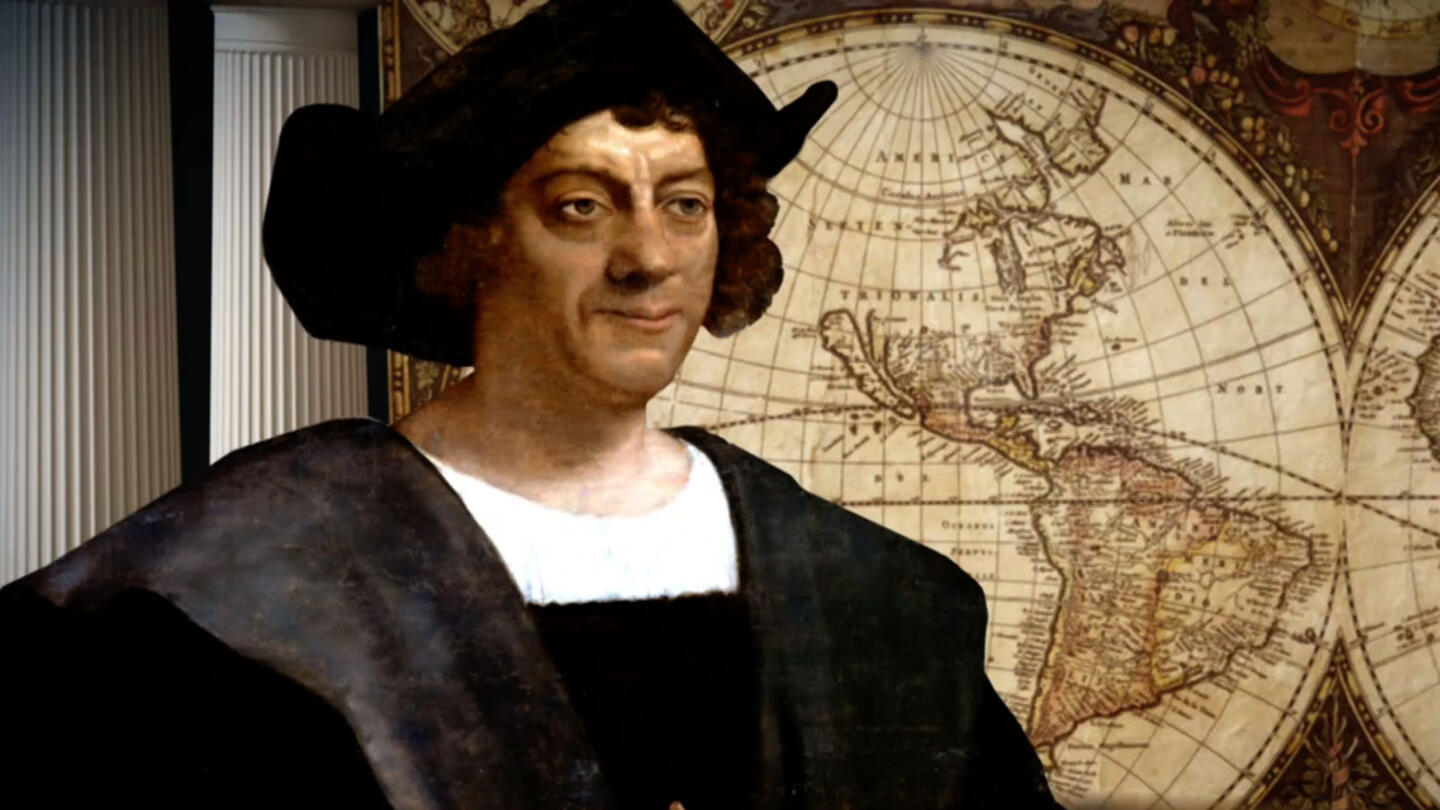
This is the real Columbus Day: After sailing across the Atlantic Ocean, Italian explorer Christopher Columbus saw a Bahamian island on October 12, 1492. He believed he had reached East Asia: Chris was right about the world being round, but it was bigger than he thought. His expedition went ashore and claimed the land forIsabella and Ferdinand of Spain, the sponsors of his attempt to find a western ocean route to to the far East. Columbus changed the route of history, science and culture, with incalculable effects long and short term, good and bad. He also was directly responsible for brutal treatment of Native Americans, because he was a product of the 15th Century. We honor historical figures for their positive achievements, and if they are positive and important enough, the personal and public evils such figures might have also had on their ledgers are secondary. That is as it should be: the alternative is to honor no one at all, and to make history a parade of villains….
…although I would be hard pressed to find anything negative to say about the amazing Desmond Doss, who became the first Conscientious Objector to be awarded the Medal of Honor on this date in 1945. Ethics Alarms told his astounding story here, in 2017; so did the film “Hacksaw Ridge.” I still have a hard time believing it.
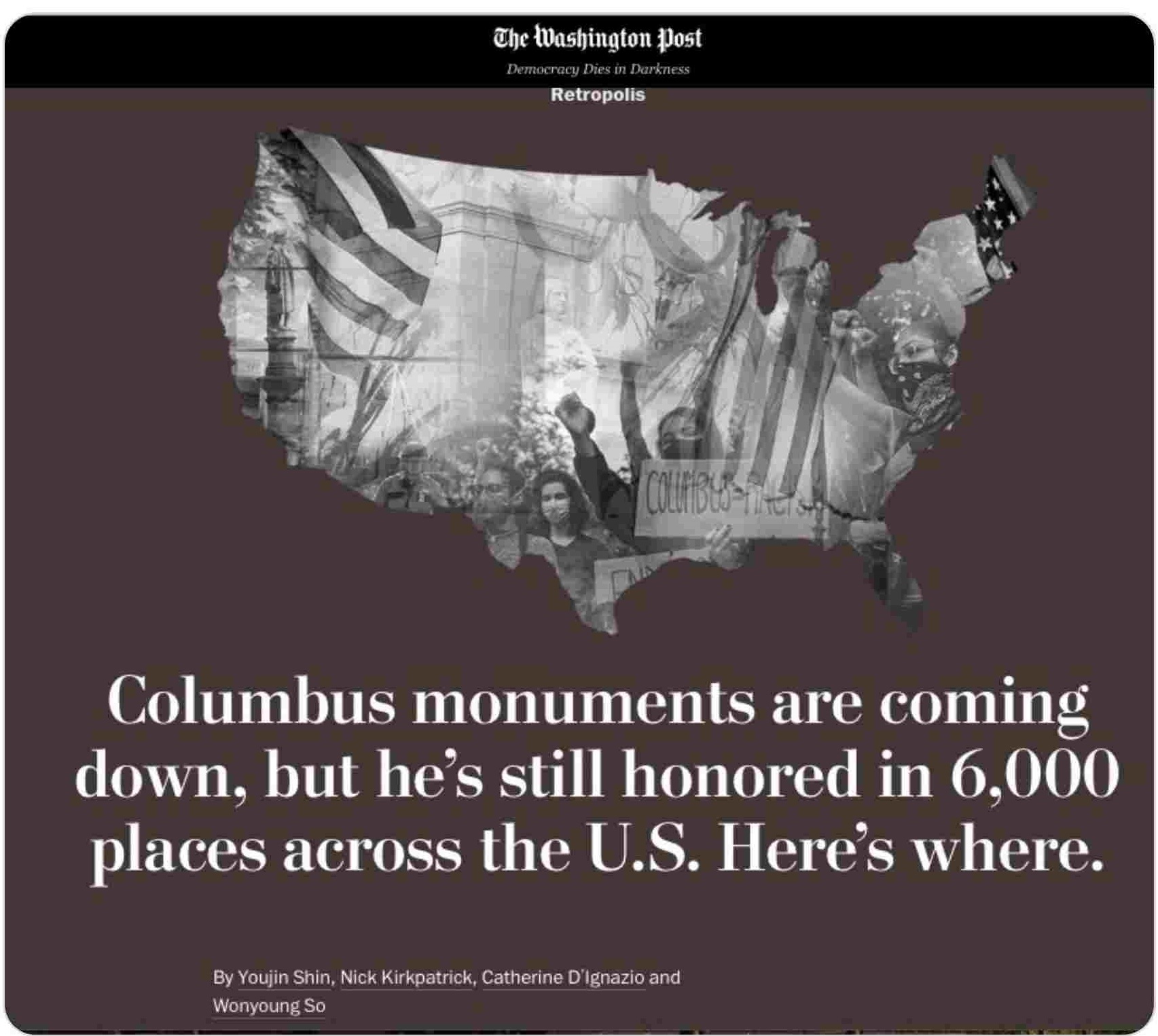
1. Nah, there’s no mainstream media bias! (#1): Here is the Washington Post, deliberately promoting statue toppling with a handy-dandy guide. This is the kind of thing that made me stop subscribing to my hometown paper. It does not explain why I subscribe to the Times, which just raised its rates to 90 bucks a month.
2. Nah, there’s no mainstream media bias! (#2): From Sunday’s “Reliable Sources” on CNN (That’s the hangout of absurdly unreliable Brian Stelter, who pretends to opine on journalism ethics while having none of his own):
Once respectable liberal journalist James Fallows, now employed by the extreme left-wing “Atlantic”: “The struggle for us all in the media is if we keep pointing out that one side of the political divide is actually instigating these things, defying subpoenas, trying to renege on the debt, holding up State Department appointments, et cetera, we are conscious of seeming shrill, we’re conscious of seeming unbalanced, we’re conscious of seeming to take a side. And so it’s something about our culture, we need to figure out how we can give out a narrative of the actual realities recognizing how this is at odds with our conventions.”
Oh, no! Seeming to take a side when they are taking sides? Seeming to be shrill when they are shrill? “Actual realities,” meaning “our biased views, represented as irrefutable truth to accomplish our agendas”? Whatever shall good journalists do? Wow. [Pointer: Steve-O-in NJ]
Mrs. O’Leary’s cow may be the most unethically maligned animal in U.S. history. On October 8, 1871, something caused flames to spark in the Chicago barn of Patrick and Catherine O’Leary. The resulting two-day conflagration killed 200-300 people, destroyed 17,450 buildings, left 100,000 homeless and caused about $4 billion of damage in today’s dollars. While the fire was still raging, The Chicago Evening Journal reported that it all started “on the corner of DeKoven and Twelfth Streets, at about 9 o’clock on Sunday evening, being caused by a cow kicking over a lamp in a stable in which a woman was milking.” Then a verse to a popular song was added; pretty soon it was the only verse anyone remembered:
Late one night, when we were all in bed, Mrs. O’Leary lit a lantern in the shed. Her cow kicked it over, Then winked her eye and said, ‘There’ll be a hot time in the old town tonight!’
There was never any convincing evidence that a cow started the blaze. The O’Learys had five cows, and they didn’t have names. It’s not even a sure thing that the fire started in the barn, but Mrs. O’Leary was a Catholic woman and an Irish immigrant, and Chicagoans were eager to have a scapegoat, or rather scapecow. One prominent historian who has studied the inquest transcripts believes that the true culprit was an O’Leary neighbor named Daniel ‘Pegleg’ Sullivan, who hobbled into the O’Leary barn to smoke a pipe, which then fell into a pile of wood shavings and subsequently started the fire. Nonetheless, Catherine O’Leary was ostracized, and became a recluse. In 1997, the Chicago City Council officially exonerated Mrs. O’Leary and her cow, which did just about as much good for Mrs. O’Leary as for the cow.
1. A new book shows that I have not lived in vain! Yesterday, a line from a depressing movie called “Kodachrome” sent me into one of my funks. During one of the many arguments between a dying artist and his middle aged son who hates him, the father (Ed Harris) sneers that he may have been a neglectful father, but at least he would leave something of importance when he died, unlike his son, a failed rock band recruiter for a record label. By purest luck, today I received a complimentary copy of “Reginald Rose and the Journey of 12 Angry Men,” a fascinating and thoroughly researched account of how the TV screenplay and the film came to be the iconic works they are. Author Phil Rosenweig also tells the weird story of how Rose lost control of the stage version of his work, and how for years the only script one could legally perform was a hack adaptation of the movie by a writer who didn’t understand it. Well, I’m part of that weird story, as is my old theater company, “The American Century Theater,” which became the first professional theater in the U.S. to present the screenplay on stage. Many were involved in the success of that production, including my wife,Grace, who produced the script by meticulously typing the screenplay from a recording of the movie (this was before the internet), and NPR critic Bob Mondello, who traveled by bus, in the rain, to a converted school auditorium to see the production, which he gave a sensational and much circulated review. There were many twists and turns after that, but eventually Rose’s version of “12 Angry Men” became the play most theaters produce. He got the respect he deserved, the endurance of the play, which is a genuine classic (I directed it four times) is assured, and yes, I was part of the reason why. Rosenweig, who interviewed me, accurately relates my role in the off-stage drama. You can find the book on Amazon, and here.
My late friend Bob McElwaine was of another era for sure. Once an active Hollywood publicist with many A-list clients, Bob once peddled his memoirs to publishers. He was an excellent writer with a great sense of humor, but was told repeatedly that unless he included “dirt” on his famous friends, girl friends and clients (like Danny Kaye, Robert Mitchum, Janet Leigh and Dean Martin) the book was a non-starter. Bob refused. “My clients hired me to be discrete and to keep their secrets,” he said. “It doesn’t matter if they are dead now: I’m not betraying them for a check.” (Bob did tell me some his experiences, knowing that I would not publish them. Yikes!)
Well, Bob is dead, and so is his brand of professionalism, trustworthiness and honor, as two forthcoming books demonstrate.