In yesterday’s Independence Day post, I challenged readers to present “an honest, factual, non-ideological defense” of the University of North Carolina’s decision to award a tenured faculty position in journalism to to New York Times race huckster and “1619 Project” propagandist Nikole Hannah-Jones. I did not expect a serious response, much less a persuasive one, as the challenge was, in my mind, akin to challenging someone to translate the Zodiac Killer’s code.
I’m not sure if I can offer a “non-ideological defense” of the UNC Trustees’ reversal in the Hannah-Jones case. But I can say I’m one of the few people in the country who sees the decision as neither a triumph nor a capitulation. And I suppose that as one of the more liberal of your readers and as a veteran of three decades in tenure-track and tenured positions at colleges and universities, I might be the logical… erm… advocate?
So… Unless things work fundamentally differently in North Carolina than in the state university systems with which I’m more familiar, there are some things the average person might not completely understand.
Let’s play the ever more popular quiz show, ” Is It Racist?”!
Today’s topic: Late-night television host James Corden has long featured on his show a food-centered “Truth or Dare” variation called “Spill Your Guts or Fill Your Guts.” Celebrities choose to either answer personal questions or take a bite of a food that most viewers would deem nauseating or not properly food at all. Recently the cherubic British comic employed a table in the bit filled with Asian delicacies like chicken feet, pig’s blood and thousand-year eggs.
Kim Saira, 24, a Los Angeles activist who organized the petition, told an interviewer, “James Corden is a white person and is actively using ingredients from Asian cultures and profiting from it and showing it in such a negative light. There’s a way to not like foods and still be respectful about it.”
The New York Times interviewed Lok Siu, an associate professor in the Department of Ethnic Studies at the University of California, Berkeley who agreed that Corden’s joke is indeed racist because it disrespects people’s cultures. The choice of Asian foods to highlight as disgusting to typical Americans makes Asian Americans feel more vulnerable or marginalized.
Really, Professor?
Oh yes indeed! “You use food as a metaphor to describe that distance, the kind of strangeness between a group of people that you don’t understand and their habits, the way they’re eating, the smell that comes with the spices,” she said. “There’s something around the way we discuss food, the way we think about food in our acceptance or rejection of it, it’s a rejection of a culture and the people that’s associated with it.” Siu regards the food as a metaphor for Asians not qualifying as “normal.”
This Comment of the Dayon today’s Fourth of July post, by Steve-O-in NJ, needs no introduction. Neither does he, as the Ethics Alarms leader in Comments of the Day with more than 30 before this one.
Today we celebrate the birthday of the United States, well, some of us do, anyway.
Some say that today means nothing, because the actions of men more than two centuries ago do not match up with the opinions of people not even two years ago. Others say that today never meant a thing, because this nation is a bad nation that’s just happened to get it right once or twice. Thank God this generation is finally getting it right, and we’re finally moving past the past 245 years, they say. We can’t go back and change the results of the elections in 2016, 2000, and 1980, we can’t go back and convince Teddy Roosevelt not to run in 1912, we can’t go back and stop Congress from declaring war on Spain in 1898, we can’t go back and prevent the Civil War, and we can’t go back and convince the Founding Fathers to abolish slavery right out of the gate in 1787, they say. We can’t go back and make cooler heads prevail in 1775, or stop the arrival of slaves in 1619, or make Columbus turn back, they say. However, we the people of today can break with all of that, and move forward with a new nation, unfettered by that past. None of it means a thing. It’s tainted.
I seem to remember a man born Saloth Sar, better known as Pol Pot, saying it was now Year Zero and everything before was nullified. You can look up what happened there. I also seem to remember a man born Vladimir Ilyich Ulyanov, later called Lenin, saying everything that came before was tainted and needed to be erased. You can look up what happened there too. Before that a revolutionary parliament that included such luminaries as Maximilien Robespierre declared it to be Year One of a new age, with the months of the year renamed completely and weeks of seven days replaced by weeks of ten. You can also look up what happened there.
There are so many important and fascinating things associated with the Fourth of July, and “The Stars and Stripes Forever” is one of them. In his autobiography, “Marching Along,” Sousa wrote that he composed the march on Christmas Day, 1896, on board an ocean liner on his way home from a vacation with his wife. He had just learned of the death of David Blakely, the manager of the Sousa Band and was moved to create his most stirring march—which for Sousa is saying a lot— as a personal tribute. He composed the march in his head, not writing any notes down until he arrived in the U.S. The piece was first performed at Willow Grove Park, a Philadelphia suburb on May 14, 1897, and was an instant hit, as you would expect. An Act of Congress in 1987 made it official National March of the United States of America, so I assume that Gwen Berry hates it too, along with the Star Spangled Banner. (Gwen, arrogant and ignorant social justice warrior that she is, was recently exposed as racist and hypocrite with some old tweets that surfaced. Hilariously, she has defended herself by comparing her plight to that of Justice Kavanaugh, as if 1) she had ever defended Kavanaugh when he was being smeared, 2) there was any verifiable evidence against Kavanaugh as opposed to her smoking gun tweets, and 3) there is no distinction between a 35-year old rumor about a distinguished judge’s conduct as a child and published proof of an obnoxious athlete’s character as an adult. But I digress…)
In show biz, and particularly in the theater and the circus, Sousa’s masterpiece is sometimes called “the Disaster March,” because it was once common for theaters and circuses to have their bands or orchestras play it to alert the audience that there was a dangerous emergency, like a fire. (Yes, it is ethical to play “The Stars and Stripes Forever in a crowded theater). The idea was that the number was a code for staff that allowed them to organize the audience’s orderly exit without causing panic. The march was played, for example, during the Hartford circus fire of July 6, 1944.
One of the strangest and oddly fitting coincidences in U.S. history occurred on July 4th, 1826, when two of the primary architects of American independence, John Adams and Thomas Jefferson, died within hours of each other.
Happy Fourth of July, everyone. Since the very first, the holiday has never been celebrated while under such cultural attack. Don’t let the propaganda of America’s haters diminish one of the most glorious and beneficent days in world history.
1. What do we make of this Gallup poll?In a generally confusing set of results, the one stand-out in the recent Gallup poll regarding public’s perceptions of the state of the pandemic was that 57% of Republicans think its over and only 4% of Democrats do. That’s a huge gap, showing an alarming disparity in world view, perception, attitudes and thought process. I tend to view part of the 4% as confirmation bias: conservatives are far more resentful of the State’s incursions on their personal liberties using the virus as a justification (or an excuse) than the totalitarianism-enabling Left. On the other hand, and there are many other hands here, being certain that the pandemic is over is dumb, since if we have learned on thing about the health care “experts,” they have been wrong as often as right. We have also learned that politics has driven the narrative about the virus as much as the facts have. I thought Democrats trusted science, and the GOP doesn’t. That would suggest that the latter would be more wary of the current green lights.
On yet another hand, Republicans tend to be far less risk averse than modern Democrats, adopting the traditional spirit of the nation that Democrats are in the process of rejecting. Gallup does not give the party- affiliation breakdown of the 40% of those polled who say that the nation will never return to normal. I know lots of Democrats who say now that they plan on wearing masks forever, and no Republican. On the OTHER hand, a non-Democrat could easily conclude that we will never return to pre-Wuhan normalcy because power-wielding Democrats will never allow it.
What would be more accurate term? Well, “asshole” comes to mind.
A Frederick County deputy pulled over a vehicle for a tag violation on June 20 when he noticed another vehicle pull up nearby. The deputy reportedly first feared for his life, and that it could be a cop assassination set-up. But the driver of the second vehicle introduced himself as Democratic county councilman Kai Hagen, and he refused to leave the scene until the detained driver, an African-American, acknowledged that he was “OK.” County Sheriff Chuck Jenkins, a Republican, went on WFMD-AM’s “Mid-Maryland Live” last week to condemn the grandstanding Councilman.
“I’m enraged, I’m angry, I was livid when it happened, there’s no excuse for it, it’s unlawful,” Jenkins said. “This is outrageous. Who in the hell does he think he is?” Jenkins added, while noting that Hagen could legitimately have been cited for his actions.
Not could have been, should have. The deputy handled the matter badly, falling for the old “Do you know who I am?” trick. It doesn’t matter who the interloper was. He was interfering with lawful law enforcement.
Hagen then called in to the radio station to explain his conduct, confirming that he had turned his vehicle around and circled back to the scene to ensure that the stopped driver was all right when he noticed his skin color—you know, that he wasn’t being beat up, shot, having drugs planted on him, being made to sing “The Camptown Races” or having his neck knelt on, which we all know is what white cops want to do to blacks.
[I started to write a new post and while doing my research discovered that I would basically be repeating what I posted last year. Thus I am re-posting that July 3 Gettysburg essay as well as the one I attached to it, but with several substantive additions.]
July 3 was the final day of the pivotal Battle of Gettysburg in 1863, reaching its bloody climax in General Robert E. Lee’s desperate gamble on a massed assault on the Union center. In history it has come to be known as Pickett’s Charge, after the leader of the Division that was slaughtered during it.
At about 2:00 pm this day in 1863, near the Pennsylvania town of Gettysburg, Lee launched his audacious stratagem to pull victory from the jaws of defeat in the pivotal battle of the American Civil War. The Napoleonic assault on the entrenched Union position on Cemetery Ridge, with a “copse of trees” at its center, was the only such attack in the entire war, a march into artillery and rifle fire across an open field and over fences. When my father, the old soldier, saw the battlefield for the first time in his eighties, he became visibly upset because, he said, he could visualize the killing field. He was astounded that Lee would order such a reckless assault.
The battle lasted less than an hour. Union forces suffered 1,500 casualties,, while at least 1,123 Confederates were killed on the battlefield, 4,019 were wounded, and nearly 4000 Rebel soldiers were captured. Pickett’s Charge would go down in history as one of the worst military blunders of all time.
At Ethics Alarms, it stands for several ethics-related concepts. One is moral luck: although Pickett’s Charge has long been regarded by historians and scholars as a disastrous mistake by Lee, and in retrospect seems like a rash decision, it could have succeeded if the vicissitudes of chance had broken the Confederacy’s way. Then the maneuver would be cited today as another example of Lee’s brilliance, in whatever remained of the United States of America, if indeed it did remain. This is the essence of moral luck; unpredictable factors completely beyond the control of an individual or other agency determine whether a decision or action are wise or foolish, ethical or unethical.
Pickett’s Charge has been discussed on Ethics Alarms as a vivid example, perhaps the best, of how successful leaders and others become so used to discounting the opinions and criticism of others that they lose the ability to accept the possibility that they can be wrong. This delusion is related to #14 on the Rationalizations list, Self-validating Virtue. We see the trap in many professions and contexts, and its victims have been among some of America’s greatest. Those who succeed by being bold and seeing possibilities lesser peers cannot perceive often lose respect and regard for anyone’s authority or opinion but their own.
I lost an ethics training client over the issue now raising its ethically-muddled head in New Jersey. Several years ago, during a day long seminar I taught for a teachers association, I stated that a teacher who taught grade school, middle school of high school students while pregnant and unmarried was harming her students, and that responsible school were ethically entitled to make pregnancy outside of marriage grounds for dismissal. Literally all of the attendees were outraged (even the two men in the group), though none could articulate a valid argument against what I said. (“The right to choose!” is not a valid argument in this context.)
I was right, they were wrong. The controversy now over a Catholic school art teacher who is demanding that she should have been able to keep her job despite being pregnant is much easier, or should be.
Victoria Crisitello was an art teacher at the New Jersey’s St. Theresa elementary school in Kenilworth. In the course of negotiating for a raise, she mentioned that she was having a baby. Weeks later, she was fired by the principal, a Roman Catholic nun, who explained that she was being terminated “because she was pregnant and unmarried.” “Sex out of wedlock violates a fundamental Catholic belief that the school in this instance felt it could not overlook,” lawyers for St. Theresa’s wrote in a petition to the state Supreme Court. Crisitello’s lawsuit was tossed out by two trial court judges, only to be restored each time when an appeals court sided with the ex-teacher. Now the state’s highest court, acting on an appeal by the school, has agreed review the case, which raises the continuing thorny question about the relationship between the government and religion.
I was afraid of this: devoting the warm-up to Gettysburg left me with all of these noisy ethics stories hanging around my office and yelling at me. So here are some ethics stories and issues to unclog the drain…
The Supreme Court denied certiorari in Arlene’s Flowers v. Washington, letting stand a 2019 decision by the Washington Supreme Court against florist Barronelle Stutzman, the owner of Arlene’s Flowers, for refusing to supply flowers for a same sex marriage. Upon reading the decision of the Washington Court, I was struck by the fact that the plaintiffs were not individuals who had made the request deliberately to force a confrontation with a vendor they knew had religious objections to same sex weddings. Robert Ingersoll had been a regular patron of Arlene’s Flowers for years, so it seemed natural for him to use the shop to supply the floral arrangements for his wedding to Curt Freed. Nor did their truncated conversation involve special requests for any particularly expressive arrangements. Florist Barronelle Stutzman just refused to sell any flowers to the couple for their wedding and reception, and that was it. The case was ruled one of discrimination in public accommodations, and the opinion went to great pains to say that no animus against the defendant’s religion was involved.
SCOTUS turns down cases for many reasons, and in contentious social matters, they often will reject a case that has too much gray, triggering the “hard cases make bad law” principle. Cakes, catering, photographs and flowers at weddings fall in various places along the “commodities/art” spectrum, depending on the specific facts of each case. This one is too close. The florist wasn’t asked to deliver the flowers or to participate in the marriage in any way. There’s got to be better case on this topic somewhere. The Court was wise to pass.
And the florist was the jerk here. I don’t have much sympathy for her. Selling flowers to a gay couple doesn’t entail an endorsement of gay marriage, kinky sex, or anything else. Continue reading →
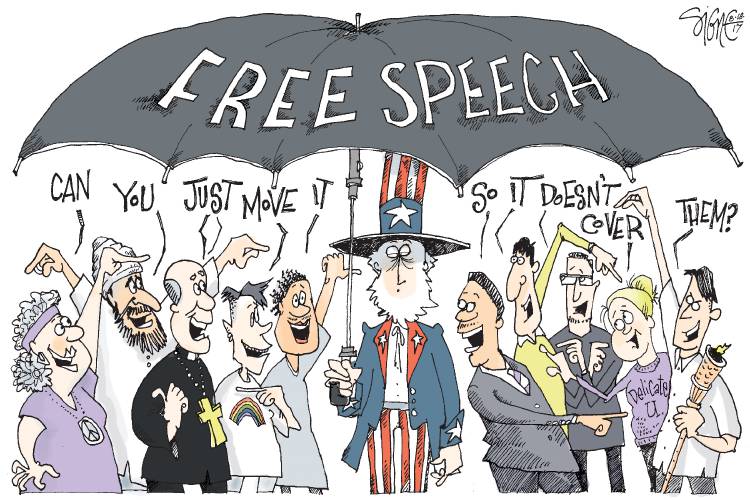
How did we get to the point where “liberals” want to chip away at the freedoms of speech and association while conservatives defend it? It’s weird: I’m old enough to remember when those mean old conservatives were always trying to silence dissent, not to mention vulgarity and violent TV shows and movies.
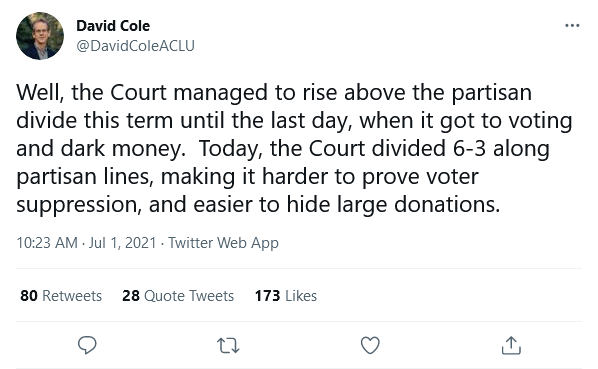
But in the final day of the Supreme Court’s term, the 6-3 conservative majority ruled that California—from which all terrible ideas now seem to flow— may not require charities soliciting contributions in the state to report the identities of their major donors. The law was opposed by very unconservative voices like those of ACLU to the NAACP Legal Defense and Educational Fund, and one would think that the alleged liberals on the court would immediately recognize how the law could and would chill free speech. Or don’t they pay attention to the incidents where CEOs have been run out of their jobs for contributing money to anti-gay marriage organizations, to name just one example? It would seem not. This is also weird, for the cancel culture has made simply stating an opinion that contradicts the Woke Borg perilous to one’s career, personal relationships and safety. Is it overly conspiracy-minded to suggest that progressives want it that way, particularly with their success at making wiggly-spined Americans who would make Patrick Henry retch grovel for forgiveness.
Chief Justice Roberts neatly summarized the importance of free association, writing,