Ethics Heroes: The U.S. Supreme Court

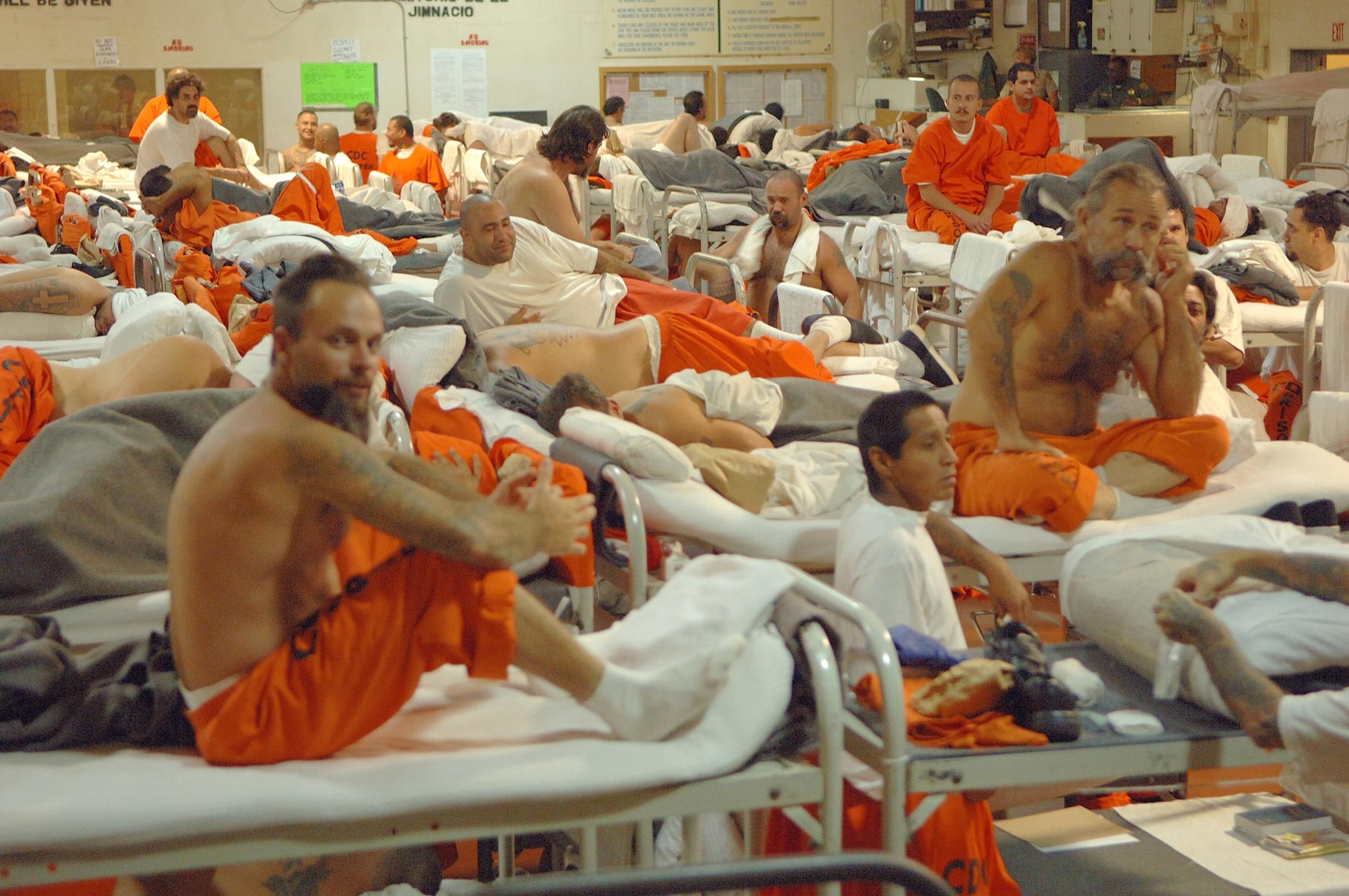
To be more accurate, the heroic component in this instance is the liberal wing of SCOTUS ( Justices Sotomayor, Kagan, Ginsberg, and Breyer) plus the swing vote, Justice Kennedy, who wrote the majority opinion in Brown v. Plata.  The decision upheld a court order requiring California to release a staggering 46, 000 inmates of its prisons, more than a fourth of the those sentenced there. The majority concurred with the lower court’s assessment that California prisons were so obscenely over-crowed that conditions amount to a human rights violation and a breach of the constitutional prohibition on “cruel and unusual punishment.”

Some Supreme Court decisions come down to ethics as much as law, and this was certainly one of those times. At issue from a legal standpoint was  whether federal judges had the power to order the release of state prisoners as a necessary means of curing a constitutional violation. But the brilliant legal minds on the conservative side of the Court’s divide had no problem answering that question in the negative, and persuasively too.  The dilemma is that California’s least sympathetic citizens, its residents of the state’s penal institutions, are being kept in conditions that violate their constitutional rights, and despite many years of knowing about the problem, the state hasn’t found a way to rectify it. Continue reading

Comment of the Day: “The Ethicists, Backing Judge Walker and Gay Marriage, At An Unacceptable Price”

The motion to vacate Judge Walker’s ruling on Proposition 8 has been filed, you can read it here. Since the original post, I have detected some cracks in the formerly near-united front of legal ethicists and journalists deriding Walker’s critics. Some of them are finally, grudgingly, admitting that the Judge might not have handled his potential conflict so well after all, and that the motion is not a frivolous, anti-gay outrage as they originally labelled it.  The most rickety of the rationalizations put forth on Walker’s behalf, advanced by some his most respected defenders, is that he had no obligation to reveal his own sexual orientation by disclosing his domestic arrangement because of its intimate and private nature. Yet the judge voluntarily disclosed it after his decision was in the books, raising a rebuttable presumption that his original silence was to avoid suggestions of conflict, not out of a desire for privacy.

First time commenter Jada adds her Comment of the Day to the discussion: Continue reading

The Ethicists, Backing Judge Walker and Gay Marriage, At An Unacceptable Price

"Oh, all right...as long as we like the decision."

Thanks to the Judge Walker controversy, now have proof that the best legal ethicists in the nation are human. I suppose that’s something.

My colleagues in the legal ethics field are arguing—decreeing, really— that Judge Vaughn Walker’s decade-long same-sex relationship didn’t need to be disclosed before he ruled against Proposition 8 (California’s voter-approved gay marriage ban) because, they say, it created no reasonable doubts about his impartiality. Coincidentally, they also really, really like his decision. But then, so do I. Continue reading

Judge Walker Was Wrong

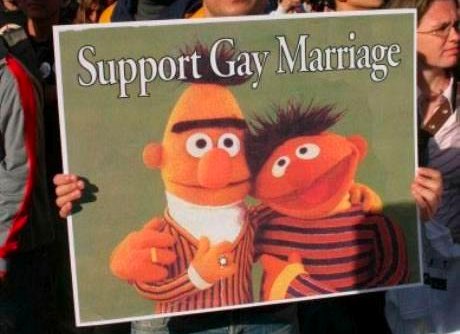
Now that we know about Bert, should Judge Ernie have recused himself?

Judge Vaughn Walker, the Federal District judge who a year ago ruled California’s Proposition 8, which banned same-sex marriages, unconstitutional, was wrong. No, not about the law, which is pretty clearly unconstitutional: his opinion was fair and well-reasoned, and is likely to be upheld on appeal. Walker was ethically wrong in his handling of the delicate issue of his own sexuality, which had raised a controversy about his objectivity and ability to be impartial.

Two weeks ago, following his retirement from the bench, Walker publicly disclosed for the first time that he has been in a same-sex relationship for the past ten years. This changes the analysis regarding the propriety of his ruling on Perry v. Schwarzenegger. Walker had long been rumored to be gay; supposedly “everybody” knew he was gay. My position, as well as that of many others considering the arguments of anti-gay marriage opponents that he should recuse himself, was that sexual orientation could not and should not create a presumption of bias, any more than gender, age, race or marital status. Continue reading

A Strong Consequentialist Argument for Steve Jobs’ Liver…But Is It Right?

Steve Jobs and friend

Back in June of 2009, when “Ethics Alarms” was but a twinkle in my eye, there was a momentary controversy when ailing Apple CEO Steve Jobs was able to use his enormous wealth to land on multiple regional organ transplant lists, thus vastly improving his chances of getting a precious liver transplant in time to save his life. The California native ultimately got a Tennessee liver, but critics cried ethics foul. The organ transplant distribution system is not supposed to be based on wealth: otherwise, why not just auction off livers to the highest bidders? Because most insurance companies won’t cover multiple listings, only the richest patients can afford to employ this strategy, meaning that a system that is supposed to be means-neutral favors the wealthy after all. Continue reading

When a Law Makes a Problem Worse

Where should we file this legislative botch? Perhaps we should file it under incompetence, lack of diligence, irresponsibility, or inexcusable ignorance of unintended—but completely predictable–consequences.

In California, a statute  passed overwhelmingly by the State Legislature required that lawyers who work on loan modification agreements for homeowners facing foreclosure cannot require any payment until the work is complete. The law was intended to eliminate unscrupulous firms from running scams on desperate Californians, more of whom face foreclosure than in any other state, in which the firms charged large up-front fees and then did nothing. Unfortunately, it also made it unprofitable and risky for legitimate, honest lawyers to put in many hours battling lenders skilled at running out the clock in the hopes of being reimbursed by clients who are already in financial deep water. Thus stressed California homeowners, having been given protection by their tunnel-visioned representatives, now can find no legal help at all, honest or otherwise. Continue reading

Anatomy of an Unethical Class Action Lawsuit, Badly Reported, Exposed by a Blogger

Here is how the Washington Post begins its story about the most recent assault on McDonald’s by the people who want to control your eating and parenting habits:

“The D.C.-based nutrition watchdog group Center for Science in the Public Interest has helped a California mother file a class-action suit against McDonald’s, demanding that the burger chain stop marketing toys to children. The woman, Monet Parham of Sacramento, claims that the marketing of Happy Meal toys has interfered with her ability as a parent to provide her two children with a healthful diet. Here’s a quote:

“I am concerned about the health of my children and feel that McDonald’s should be a very limited part of their diet and their childhood experience,” Parham said. “But as other busy, working moms and dads know, we have to say ‘no’ to our young children so many times, and McDonald’s makes it that so much harder to do. I object to the fact that McDonald’s is getting into my kids’ heads without my permission and actually changing what my kids want to eat.”

This is fairly typical of the hundreds of news stories on the web about the lawsuit. Over at Popehat, Patrick, the wittiest of the site’s witty staff, performs a crushing dissection of the lawsuit, the story, and the media’s incompetent reporting of it. You see, he writes..

“…Monet Parham is really Monet Parham-Lee.  Monet Parham-Lee is the name that Monet Parham uses professionally.  Monet Parham-Lee is represented in the suit by attorneys affiliated with the Center for Science in the Public Interest.  Meaning Ralph Nader.  Monet Parham-Lee is an employee of the California Department of Public Health. Monet Parham-Lee works in the “Cancer Prevention and Nutrition Section” of the California Department of Public Health. Meaning that Monet Parham-Lee is tasked, professionally, by the State of California with ensuring that Californians eat their vegetables.  The power that the State of California grants Monet Parham-Lee evidently is not enough.  Monet Parham-Lee is taking the law into her own hands, to ensure that not only her own children eat their vegetables, but that everyone else is forced to make their children eat vegetables.” Continue reading

Welcome to The Nursing Blog! Next?

Dr. Chris MacDonald, the articulate Canadian ethicist who is already the proprietor of the best business ethics blog on the Web, is apparently on a mission to bring ethics to every corner of the professional landscape, and all power to him. He is already a collaborator on the useful Research Ethics Blog , a co-writer of The Food Ethics Blog, and the primary force behind the Biotech Ethics website. Now, along with Dr. Nancy Walton, his partner on the research ethics site, he is launching a new ethics blog, on the topic of nursing. The Nursing Blog is a great idea, for a profession that faces persistent, difficult, and daily ethical issues. As Dr. Walton says in the debut post, there is a need. Whenever I learn about professional blogs, I pass on the links in seminars with those professionals: nothing strengthens ethical instincts and conduct better than a daily dose of thoughtful discussion or debate on ethical issues related to one’s own field. Bravo and brava, Doctors McDonald and Walton! And thanks.

While I’m thinking about it, I have some other ethics blog ideas for Chris to consider as he broadens his ethics blogging empire.

How about a horny lawyers ethics blog, for example? Clearly one is needed. Another need: a New Jersey Turnpike employees ethics blog….and fast. There is also a pressing need for a prosecutors ethics blog, since California’s bar is investigating 130 of them for wrongdoing. I know there are a few such blogs already, but clearly, they are not enough. And, of course, we are waaay overdue for a Public Broadcasting fairness and integrity blog.

So congratulations, Chris…but you still have a lot of work to do.

Fox News Sunday Ethics Revelations: Wallace and Fiorina

Two things were stunningly in evidence during today’s interview of GOP Senate candidate Carly Fiorina (trying to unseat Barbara Boxer in California) by anchor Chris Wallace on “Fox News Sunday.”

The first is that Chris Wallace does not conform to the media stereotype of a Fox journalist, a thinly veiled Republican operative committed to pushing a conservative agenda. If only interviewers on CNN, NBC, CBS and ABC were so unwilling to accept evasion, half-truths and nostrums from Democrats. Kudos to Wallace for doing his job, not lobbing softballs, and exemplifying journalistic integrity where most people least expect it.

The second is that candidate Fiorina, yet another Tea Party darling, is a fake. Continue reading

“Yes, THESE Figures Were Outrageously Mistaken, But You Should Trust Our OTHER Figures Completely!”

Question: What ethical conclusions can one reach from this story about the great, environmentally responsible state of California?

From the San Francisco Chronicle:

“California grossly miscalculated pollution levels in a scientific analysis used to toughen the state’s clean-air standards…The pollution estimate in question was too high – by 340 percent, according to the California Air Resources Board, the state agency charged with researching and adopting air quality standards. The estimate was a key part in the creation of a regulation adopted by the Air Resources Board in 2007, a rule that forces businesses to cut diesel emissions by replacing or making costly upgrades to heavy-duty, diesel-fueled off-road vehicles used in construction and other industries. Continue reading