To kick off the Not-Too-Early-To-Play-Christmas-Music Season, here is a Comment of the Day that adds another chapter to the Ethics Alarms commentary on “White Christmas,” the Bing Crosby-Danny Kaye musical film that is one of the five or six most resilient of the Christmas classics. The initial ethics analysis is here.
The post that spawned the latest take was a rare guest essay by Ethics Alarms veteran texagg04.
Now comes new commenter SykesFive to provide insight into the pivotal character of General Waverly, played by Dean Jagger. Among other things, he argues that one reason the general was so beloved was that he was poor general, treating the lives of his men as more important than his mission.
I have a somewhat different take on this. I sometimes think I am the only person who thinks so much about the Waverly character.
As the scene opens, Major General Waverly is being relieved for frankly the only reason American unit commanders were relieved during the war: he didn’t take the objectives. That is failure. It could be lack of aggression or poor coordination or anything else, but ultimately it is failure and the commanding officer will pay the price. He will be shuffled off to a rear area command, or maybe just left to bum around the theater, and be out of the Army by the end of 1945 because his record will be so tarnished. He will be lucky not to revert to his prewar rank.
Waverly’s age suggests he was a company-grade officer during WWI and may or may not have seen combat during that conflict’s closing weeks, then spent decades idling in the interwar army. Apart from whatever happened in 1918, Waverly has no more combat experience than anyone else in the division. He is not an experienced commander by any measure. He had the right credentials–a few articles in service journals, no serious problems on his posts, and of course a West Point Ring–but had never really been tested as a field-grade officer. Again this is a common profile.This is a very common profile for WWII US Army division commanders.
So in 1940, let’s say Colonel Waverly seemed like a likely candidate for command of an infantry division in the expanding army. He did well enough with some trial commands–all during stateside training and expansion–and was promoted to one and then two stars. He seemed competent enough when the 151st Division was formed and went through let’s say nearly two years of intensive training in Texas or California or wherever. And so the division was sent to Europe in let’s say August 1944, then spent a couple months languishing in Normandy or the Pas de Calais region, during which time Waverly was a friendly presence at other officers’ headquarters as well as around his division. Bear in mind that at this point, and really for the whole war after the breakout from Normandy, the limit on American frontline strength was providing fuel and artillery shells. There were more men and tanks than could be sustained at the front. Continue reading →
Last year (to the day) when I posted the Ethics Alarms ethics guide to Frank Capra’s 1946 masterpiece “It’s A Wonderful Life,” one of the great ethics movies of all time, as this blog’s official welcome to the holiday season, I wrote, “I suspect we need it more in 2016 than usual.” As it turned out, we need it even more in 2017.
Multiple forces have been hard at work for a full year now, roiling the nation, painting the future as dire and the present as unbearable, trying to divide us and even to encourage discord and conflict during this special time when we are supposed to remember what is most important in life. In case you have been infected, it’s not politics and not partisan agendas, but love, family, community, kindness, and friends. The simple message of Frank Capra’s masterpiece—it has aged far better than his other films, including, and maybe especially, “Mister Smith Goes To Washington”—that no one is a failure who has friends, is vital to recall when so many are rejecting friends because they don’t conform to some ideological talking point. This is madness, and watching and heeding “It’s A Wonderful Life” is a better remedy than Thorazine.
Senate Minority Leader Chuck Schumer actually told his Twitter followers this week to bring a chart prepared by a think tank to attack the Republican tax plan during Thanksgiving dinner. This is part of the effort to politicize everything in our lives, by zealots who value power over humanity, country, and spirituality. They belong with Mr. Potter, not George and Clarence.
I need this movie more in 2017 than usual for other reasons. It has been a year in which I have lost many peers and cherished friends, and listened to too many of the living bemoan the passage of time and looming mortality. I don’t think like that—a lifetime gift from my brave and fatalist father—but I can’t pretend that the game clock isn’t running out, or not face the fact that I have not sunk anywhere near the baskets I could have and should have. Fortunately, what I wrote in an earlier year introducing this post still resonates…
Everyone’s life does touch many others, and everyone has played a part in the chaotic ordering of random occurrences for good. Think about the children who have been born because you somehow were involved in the chain of events that linked their parents. And if you can’t think of something in your life that has a positive impact on someone–although there has to have been one, and probably many—then do something now. It doesn’t take much; sometimes a smile and a kind word is enough. Remembering the lessons of “It’s a Wonderful Life” really can make life more wonderful, and not just for you.
Have a terrific Thanksgiving, everyone.
And here we go:
1. “If It’s About Ethics, God Must Be Involved”
The movie begins in heaven, represented by twinkling stars. There is no way around this, as divine intervention is at the core of the fantasy. Heaven and angels were big in Hollywood in the Forties. The framing of the tale seems to advance the anti-ethical idea, central to many religions, that good behavior on earth will be rewarded in the hereafter, bolstering the theory that without God and eternal rewards, doing good is pointless.
Yet in the end, it is an ethics movie, not a religious one. George lives an ethical live, not out of any religious conviction, but because step by step, crisis after crisis, he chooses to place the welfare of others, especially his community and family, above his own needs and desires. No reward is promised to him, and he momentarily forgets why we act ethically, until he is reminded. Living ethically is its own reward.
We are introduced to George Bailey, who, we are told, is in trouble and has prayed for help. One has to wonder about people like George, who resort to prayer as a last resort, but they don’t seem to hold it against him in Heaven. The heavenly authorities assign an Angel 2nd Class, Clarence Oddbody, to handle the case..He is, we learn later, something of a second rate angel as well as a 2nd Class one, so it is interesting that whether or not George is in fact saved will be entrusted to less than Heaven’s best. Some lack of commitment, there— perhaps because George has not been “a praying man.” This will teach him—sub-par service!
2. Extra Credit for Moral Luck
George’s first ethical act is saving his brother, Harry, from drowning, an early exhibition of courage, caring and sacrifice. The sacrifice part is that the childhood episode costs George the hearing in one ear. He doesn’t really deserve extra credit for this, as it was not a conscious trade of his hearing for Harry’s young life, but he gets it anyway, just as soldiers who are wounded in battle receive more admiration and accolades than those who are not. Yet this is only moral luck. A wounded hero is no more heroic than a unwounded one, and may be less competent as well as less lucky.
3. The Confusing Drug Store Incident
George Bailey’s next ethical act is when he saves the life of another child by not delivering a bottle of pills that had been inadvertently poisoned by his boss, the druggist, Mr. Gower. This is nothing to get too excited over, really—if George had knowingly delivered poisoned pills, he would have been more guilty than the druggist, who was only careless. What do we call someone who intentionally delivers poison that he knows will be mistaken for medication? A murderer, that’s what. We’re supposed to admire George for not committing murder.
Mr. Gower, at worst, would be guilty of negligent homicide. George saves him from that fate when he saves the child, but if he really wanted to show exemplary ethics, heshould have reported the incident to authorities. Mr. Gower is not a trustworthy pharmacist—he was also the beneficiary of moral luck. He poisoned a child’s pills through inattentiveness. If his customers knew that, would they keep getting their drugs from him? Should they? A professional whose errors are potentially deadly must not dare the fates by working when his or her faculties are impaired by illness, sleeplessness or, in Gower’s case, grief and alcohol.
4. The Uncle Billy Problem
As George grows up, we see that he is loyal and respectful to his father. That’s admirable. What is not admirable is that George’s father, who has fiduciary duties as the head of a Building and Loan, has placed his brother Billy in a position of responsibility. As we soon learn, Billy is a souse, a fool and an incompetent. This is a breach of fiscal and business ethics by the elder Bailey, and one that George engages in as well, to his eventual sorrow.
1 “Is anybody there? Does anybody care?” Everywhere I go, lawyers are talking about the David Boies scandal, which I wrote about here. I haven’t seen much media discussion about it at all. We have now seen one prominent hack lawyer, Lisa Bloom, and one prominent, skilled and respected lawyer, Boies, demonstrate high profile professional conduct that should receive serious sanctions from their profession, and it appears that most of the public and the media neither knows this nor cares.
Bloom is just a venal, incompetent, bad lawyer. The real crisis is when top lawyers blithely engage in wildly unethical conduct in a high profile case, but I doubt the public sees the difference. Very little commentary on Boies’s betrayal of the New York Times focused on the throbbing black-letter ethics violation involved. Today, a front page story in the New York Times about Black Cube, the sinister investigative crew hired by Boies to gather dirt on the Times before it blew the whistle on Harvey Weinstein completely missed this crucial element of the story. It also makes it near-certain that no one will read the report who need to know how poorly legal ethics are enforced.
Here’s the headline in the print edition: “Sleuths for Weinstein Push Tradecraft Limits.”Tradecraft? Online: “Deception and Ruses Fill the Toolkit of Investigators Used by Weinstein.” Nowhere in the article are readers informed that lawyers are forbidden, without exception, from using any contractor that regularly uses deception.
“Earlier this month, a former hedge fund employee was flown from Hong Kong to London for a job interview. Around the same time, a current employee of the same Toronto hedge fund was also flown to London for interviews. The company courting them was fake. Its website was fake. There were no jobs to be had, and the woman who set up the interviews was not a recruiter but an agent working for an Israeli private investigative firm.
This was not an episode of “Homeland” or the latest “Mission: Impossible” installment. Interviews and court papers show that these deceptions were part of a sophisticated and expensive investigative operation. The objective, according to one filing, was to gather proprietary information held by the hedge fund. The agent worked for Black Cube.”
Every single jurisdiction in the United States declares in its legal ethics rules, usually in the rule about misconduct, 8.4 (bolding mine):
It is professional misconduct for a lawyer to:
(a) Violate or attempt to violate the Rules of Professional Conduct, knowingly assist or induce another to do so, or do so through the acts of another;
…
(c) Engage in conduct involving dishonesty, fraud, deceit, or misrepresentation…
How much clearer can it be? It is unethical for a lawyer to employ someone or an organization that he or she knows routinely and reliably engages in “dishonesty, fraud, deceit, or misrepresentation.” Yet that’s the only reason anyone hires Black Cube. Conclusion: Boies breached a major ethics requirement, perhaps the most serious one there is. And why? Because a client paid him to.Continue reading →
I occasionally will vary from EA’s usual practice of publishing outstanding comments as Comments Of The Day to select one of the comments that is illuminating in a different way. This one, for example. Despite the Washington Post’s story featuring four romantic targets of Roy Moore from when he was a thirtyish Assistant DA who ranged from 18 to (oh-oh) 14, many of Moore’s conservative, evangelical, anti-gay, anti-US Supreme Court fans in Alabama…
….don’t seem fazed a bit. How can this be? The comment by Kat gives us a troubling glimpse into a) the kind of reasoning that leads to incompetents like Moore reaching high elected office; b) the typical level of discourse in the comments of most blogs and websites; c) the comments that I typically veto as not adding anything to the discussion here, and d) the end product of the U.S. public school system.
Here is Kat’s Comment of the Day, and yes, I sure as shootin’ will be back at the end…
Are you serious it has to be true because Moore is a bad guy why because he has Ethics and a Christian, give me a break. If the allegations are true that this girl has accuse pastors of the same thing then truth will come out! And to be credible I don’t believe her to be credible whatsoever if this horrible thing happened to her at 14 you don’t wait 38 years to say anything you tell your parents right away you tell the school made an interest in the other women all work for the Democrats and Hillary. I’ve seen many allegations against other Republicans come to be false! I am a woman I know women can say anything doesn’t mean it’s true ! To say you believe this just because you don’t like the guy try actually finding some evidence that’s what I noticed this country doesn’t do it believes any stupid thing someone says without actual any evidence and that’s dangerous ! When I find is not credible if someone waits for women wait until the month before the election and come out with us for 38 years no one says anything give me a break !
“Republicans in Washington seemed near panic Thursday in the light of a news report in which four women said Roy S. Moore, the Republican nominee for a United States Senate seat in Alabama and an evangelical Christian, had made sexual or romantic overtures to them when they were teenagers and he was in his 30s. Senator Mitch McConnell of Kentucky, the Republican majority leader, said Mr. Moore should step aside ahead of the Dec. 12 special election if the allegations were true.”
“Sexual or romantic overtures,” eh? We are now officially entering the Witch Hunt Zone. Bill Cosby has been accused of drugging and sexually assaulting women. Harvey Weinstein has been accused of sexually harassing many women in the workplace, as well as committing sexual assault and rape. Kevin Spacey was first accused of throwing a 14-year old boy onto a bed,and laying on top of him until the boy managed to get away—30 years ago. Now a controversial politician—he’s controversial because so many Republicans somehow think he is qualified to be an elected official when he clearly isn’t, and the only controversy is over whether they have no scruples, or are merely too dumb to be let outside without a leash—is being accused of “pursuing” three girls ranging in age between 16 and 18 and one girl who was 14 almost 40 years ago, when he was in his early thirties.
Unlike in the cases of Weinstein, James Toback, and most (I haven’t waded through all of them) of the Hollywood types now riding the Weinstein Ethics Train Wreck, only one crime is being claimed against Moore. It is also worth considering that the age of legal consent in Alabama is 16. A thirty year-old hitting on teens that young is certainly creepy, but it’s not illegal, and if Alabama says its legal, it is also saying it isn’t so creepy that the State wants to discourage it.
Thus we are left with just one accuser, Leigh Corfman, whose accusation involves alleged wrongdoing by Moore.. She says she was 14 years old in 1979 when Roy Moore introduced himself to her and her mother as they were sitting outside an Alabama courthouse. Moore was a 32-year-old assistant district attorney at the time. He offered to watch the girl while her mother went inside for a child custody hearing. Alone with her, Moore asked Corfman for her phone number, and later asked her out on a date. (We do not know if he asked her age.) On the first date, Corfman says, Moore drove her to his home about 30 minutes away, told her how pretty she was and kissed her. On the second and final date, she says, he took off her shirt and pants and removed his clothes. He touched her over her bra and underpants, she says, and guided her hand to touch him over his underwear. Corfman says she then asked Moore to take her home, and he did.
1 Yesterday there was a fascinating articleon how the famous opening chord of “A Hard Day’s Night” was (perhaps) made. I have been meaning to make a comment about the new Sirius-XM Beatles Channel, which I had occasion to listen to for many hours while being trapped in traffic jams and construction driving back and forth to Virginia Beach and Richmond, and this is a good time to post it.
I have been getting lousy, dishonest, bait-and-switch service and products with such regularity lately, ranging from an investment firm that couldn’t send the proper forms to give me access to my own money, to Verizon, which has been giving me a six-month runaround while its slooooow WiFi breaks down for days, to Progresso soup, which either decided to put what looks and feels like ground up chicken bones in its vegetable soup, or just the can I bought, that I had despaired of again seeing anything approaching excellence for the sake of excellence from a U.S. business until I returned to Disneyland or Fenway Park. The Beatles Channel makes the grade. It isn’t just the songs, which would have made the channel a hit all by themselves. Sirius-XM includes scholarship, history, musicology, rare recordings, interviews, celebrity and non-celebrity disc jockeys and cultural analysis, around the clock, with new programming every day. I’ve sat through college courses that were less thorough, and too many courses to count, in both college and graduate school, that were less informative and valuable. There are some things worth paying for, and products that are better than you expected!
2. The New York Times headline after a hard day’s night for the GOP in Virginia and New Jersey: DEMOCRATS SCORE TWO BIG VICTORIES IN TRUMP REBUKE.
I’m sure it was the koi.
This is flagrant spin and distortion, and unethical journalism. The New York Times should just put “You hate the President, you know you do” on the banner. The Times didn’t call last November’s across the board rejection of Democrats in state house races and Congress an “Obama rebuke,” though it was, and the results in Virginia and New Jersey cannot be fairly pinned on Trump. The two state governors races went pretty much as everyone assumed they would months ago. New Jersey’s result, from a very Democratic state, was a predictable rejection of its spectacularly failed and detested Republican governor, and Virginia’s election of a moderate Democrat over a Republican who tried to both reject Trump while trying to hitch-hike on some of his better positions was predictable as well.
I would also guess that the Donna Brazile revelations about the Democratic Party’s corruption is not on typical voter’s radar, so the wave of self-hating Democrats staying home that some predicted did not materialize. The Texas shooting, however, probably activated the always vigorous “The Constitution be damned, think of the children!” knee-jerk progressive block to go to the polls.
By now the Times’ routine propaganda tricks are no surprise, but the practice of attaching editorial comments connoting negative implications for the President is neither fair nor objective. But then, the news media knows this: it is attempting a coup by poisoning public opinion. This is the major ethics story—and ethics crisis—in the nation today, and has been so for a year.
3. Now a compliment to the New York Times. Finally, someone wrote an relatively honest article regarding the causes of mass shootings in the U.S. “What Explains U.S. Mass Shootings? International Comparisons Suggest an Answer” is the online version; the print edition headline is “Only One Thing Explains Mass Shootings In The United States.” Both headlines are misleading—the Times has a headline problem—but the article’s main point is correct: “The only variable that can explain the high rate of mass shootings in America is its astronomical number of guns.”
Not inadequate laws. Not enforcement. Not crazy people. Not crime. Not the NRA.
Just lots of guns.
Thank you.
The Times also correctly hints at—it could have and should have done more than hint—why we have more guns than any other country:
In the process of making a comparison between the US and Switzerland, which as the country with second highest gun ownership rate has far fewer shootings (Fun Facts! Switzerland, like Australia, isn’t the United States, and the Swiss, like Australians, are not like Americans), the Times notes,
“Swiss gun laws are more stringent, setting a higher bar for securing and keeping a license, for selling guns and for the types of guns that can be owned. Such laws reflect more than just tighter restrictions. They imply a different way of thinking about guns, as something that citizens must affirmatively earn the right to own.”
Translation: The United States protects and guarantees the inherent human right to self-defense and autonomy, and Switzerland doesn’t. In the U.S., the wise Founders, government doesn’t have to grant you the right to own a gun; you already have it. Or in other words, Switzerland isn’t the United States. (See above.) God bless America.
The Times continues under the heading “The Difference is Culture”:
“The United States is one of only three countries, along with Mexico and Guatemala, that begin with the opposite assumption: that people have an inherent right to own guns.The main reason American regulation of gun ownership is so weak may be the fact that the trade-offs are simply given a different weight in the United States than they are anywhere else.”
“May be”? That’s exactly why Swiss-style “regulation”—as in “We tell you if you can own a gun and what kind of gun you ‘need., Citizen!”—isn’t an option in the U.S. The Constitution also gives the right to speech a different “weight” than other cultures do, and the amount of certainty required to send someone to prison, and when the police can search your home, and many other examples where this nation and this culture insists that individuals and individual rights come first, not government power. The fact that the United States accepts the costs of individual liberty is what makes it the United States.
There are so many guns in the U.S. because Americans like guns, and in this country, people generally can make and get what they like. They should like guns: the United States,more than others, owes its existence to guns. Our most popular entertainment involves guns. Most of all, the #2 mandate in the Bill of Rights guarantees that every citizen begins life with the right to own guns.
Mass shootings are a side effect of the Second Amendment and the core individual right to be armed. The only way to reduce such shootings is to eliminate that right and confiscate guns. Either the currently vocal anti-gun zealots understand this and are lying, or they don’t, and are ignorant.
[The National Review has some legitimate criticism of the Times data analysis, but it doesn’t affect the validity of the Times general conclusion.]
4. Here’s the depressing ethics note of the day, or perhaps the year. On the first day of jury deliberations at the bribery trial of Senator Robert Menendez, a juror asked the judge a basic question: “What is a Senator?”
I guess a necessary voir dire question or two was omitted by the lawyers .
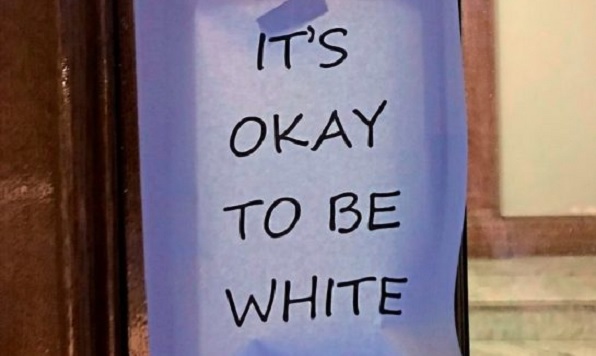
More than a dozen handmade stickers reading “It’s okay to be white” were posted around overnight in Harvard Square earlier as well as around the nearby Harvard Law School campus.
Law School Dean of Students Marcia L. Sells, who is black, wrote an email to law students in the wake of what Stephen King might call “The Stickering”:
“It seems likely that these anonymous postings, made in the middle of the night, were provocations intended to divide us from one another HLS will not let that happen here. We live, work, teach, and learn together in a community that is stronger, better, and deeper because of our diversity and because we encourage open, respectful, and constructive discourse”
Your Ethics Alarms Ethics Quiz of the Day—and watch your step!—is…
Do you think posting the stickers was unethical? Do you think the Dean’s response was responsible?
1 “These alleged actions, which haven’t been denied, are reprehensible, indefensible and unacceptable. Any elected official or state employee who has settled a sexual harassment claim should resign immediately.The people of Kentucky deserve better. We appropriately demand a high level of integrity from our leaders, and will tolerate nothing less in our state,” said Kentucky Governor Matt Bevin after it was revealed that Kentucky House Speaker Jeff Hoover (R) recently settled a sexual harassment claim made by a female member of his staff.
What an ethically clueless bit of grandstanding from Bevin. The fact that an accusation hasn’t been denied doesn’t make it true. The fact an out of court settlement was agreed to doesn’t make the accusation true either. Bevin has just painted a target on any official’s back who might have blundered across a line of workplace propriety once, and done so with an employee with an agenda, a grudge, a bill to pay, or the lack of the ethical intelligence to say, “That was wrong, don’t do it again.”
As usual with elected officials, Bevin is playing human pendulum, pronouncing an unfair and unreasonable standard in response to a culture where there previously were few standards at all.
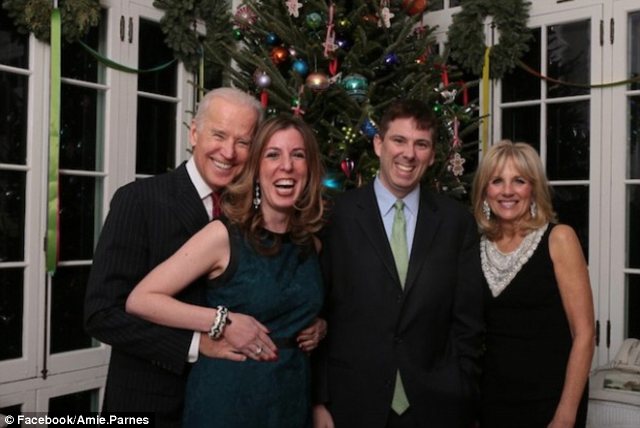
Thought experiment: let’s say the Harvey Weinstein Ethics Train Wreck revealed itself in the Obama administration, and the uncomfortable woman in this photo…
..goes to Vice President Biden after the shoot and accuses him of sexual harassment, indeed, sexual assault. Uncle Joe apologizes, swears he meant nothing by it, says he always acts like this (because he apparently does), jokes his favorite magician is “David Cop-A-Feel”, just like President George H.W. Bush, but the young woman is adamant. She says she will go to the press and file a lawsuit unless he writes a check. Reluctantly, he does.
Should the Vice-President resign? Or just learn to keep his hands to himself?
2. Sentimentalists and socialists mourning the decline of unions just got a splash of metaphorical ice water in their faces.
“DNAinfo is, at the end of the day, a business, and businesses need to be economically successful if they are to endure,” he said. Ricketts had lots money in every month of DNAinfo’s existence, while The Village Voice, The Wall Street Journal and The Daily News were also cutting staff and costs. What were his writers and editors thinking? Continue reading →
My sister, who is one of the smartest people I know, is also convinced that the Russians won the election for Trump with their secret Facebook ads, Twitter trolling and, of course, hacking of actual emails that showed exactly how sleazy and corrupt the Democrats were. (I admit, I have a hard time understanding how the latter was a bad thing for the country, a classic example of an unethical action having a fortunate result. In any event, “They let the truth out!” is a complaint that I find hard to get all choked up about.)
About the ads and fake news, however—the more I see, the more I find the evidence unconvincing, to say the least. If the Russians were just trying to make the campaign a little uglier, I guess that’s something, but from everything I’ve seen so far, they were wasting their time and money. I do find a lot of the Russian ads insulting, though. Boy, they really think we’re morons. On the other hand, except as a matter of principle, why is an incompetent Russian pro-Trump ad that wouldn’t convince anyone with the IQ of a salad fork more significant than any other idiotic ad? If Russia hired homeless people to fart around polling places, would we really regard this as an attack on democracy? Proportion is an ethical value, after all.
Exhibit A is above, a fake ad by the “Army of Jesus” inviting people to elect “a president with godly moral principles,” calling Hillary Clinton “a Satan.” I thought it was an Mad Magazine parody. Anyone so cretinous as to have his or her vote influenced by this silliness is too dumb to operate a voting machine. This junk is what Clinton bitter-enders really think turned the tide? No wonder Hillary’s excuses sound plausible: compared to this, they are compelling.
Did anyone regard Trump as having “godly moral principles”? Ever? Continue reading →
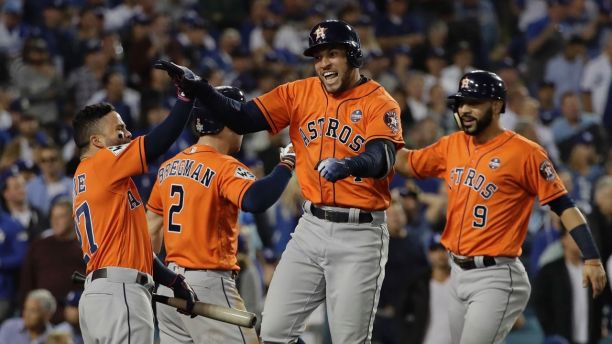
1 The 2017 World Series ended last night, with the Houston Astros winning a hard-fought and exciting seven game battle over the Los Angeles Dodgers.
Otto Von Bismarck famously observed that providence seemed to be looking out for the welfare of drunkards, fools, and the United States of America, and Major League Baseball should be added to Otto’s list. With the NFL simultaneously alienating civilized fans who don’t like seeing their heroes crippled for their entertainment, and more bloodthirsty fans who don’t want their entertainment polluted by half-baked political protests, baseball, whose ancient status as “The National Pastime” had been mocked as wishful thinking, entered the Fall at its best, and showed TV audiences a wild, passionate game featuring diverse and likeable players who seemed genuinely proud and privileged to be Americans.
Now comes the long, bleak winter…
2. From one of my smart, informed, anti-Trump obsessed progressive Facebook friends:
“So… we can talk about visa regulations right after an immigrant kills people, but we can’t talk about rational restrictions on guns when someone uses a gun to kill people?”
Rushing to take political advantage of a tragedy, as President Trump did by immediately using the terrorist attack in New York to push for his immigration reforms is, indeed, exactly as reprehensible whether it is done by Democrats or Republicans. A tactic sure looks uglier when it’s done to oppose your interests than when its done to advance them, isn’t it? (By the way, my friend, restrictions on immigration are not prohibited by the Constitution; “rational restrictions on guns,” aka “incremental elimination of the Second Amendment,” because it is now clear that this is the goal, is.)
3. A few hours after Trump’s Cabinet meeting, CNN’s Jim Acosta asked White House press secretary Sarah Huckabee Sanders, “Why did the president call the U.S. justice system a joke and a laughingstock?”
“That’s not what he said,” Sanders replied. “He said that process has people calling us a joke and a laughingstock.”
In fact, the President had indeed said at the meeting, “We need quick justice and we need strong justice — much quicker and much stronger than we have right now — because what we have right now is a joke, and it’s a laughingstock.”