Morning Ethics Warm-Up, 7/5/18: Dinosaurs, Savages, And Censors

Good Morning!

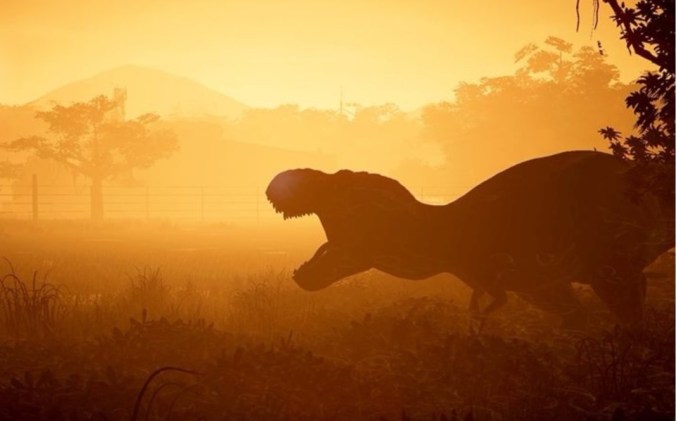
1. Jurassic World II. I can’t honestly call this ethics, but as I posted about the film’s bad reviews earlier, I feel obligated to close the loop. I saw the movie last night, and as I knew I would, enjoyed it thoroughly, beginning to end. To those who did, I feel a bit the way I do about people who don’t like baseball, Westerns, Gilbert & Sullivan, and the United States of America: I’m sorry for you. This one even has a moment that seems to be written for those who don’t to help explain those who do, when Bryce Dallas Howard talks about her sense of wonder the first time she saw a dinosaur. Of course, the original movie better expressed the same sense of wonder in the iconic scene where Sam Neill is struck dumb by his first sight of  the brachiosaurus (and the lawyer’s only reaction is “We’re going to make a fortune with this place!”), but the Howard’s speech is no less an accurate description of how we dinosaur-lovers feel when we see these creatures on-screen.

No, it’s not the equal of the first “Jurassic World,” but it is excellent for the sequel, and better, I think, than either sequel to “Jurassic Park.” A vicious mutant raptor chasing a child through Victorian mansion is the stuff of nightmares, and a new concept; the dinosaur auction to a bunch of international bad-guys was a weird cross between “Goldfinger” and “Taken,” and several scenes, including the dinosaur stampede away from the erupting volcano, were worth seeing the film all by themselves. There were also more “Awww!” scenes than in all of the previous films combined: Chris Pratt’s home movies of bonding with the raptor babies; a mother triceratops and her adorable little one, and a haunting evocation of on of Charles Addams. best, but least funny, cartoons. I’ll leave it at that.

My biggest complaints would be that there was not enough of a role for the T-Rex, some of the deliberate homages to the earlier films were ham-handed and predictable, and that there was a fatal decision by one of the villains that made no sense to me at all. These flaws were more than compensated for by the star turn of the Pachycephalosaurus,  a species that had only cameos in “The Lost World” and “Jurassic World,” a terrific fight between a new species in the series, a Carnotaurus, and a Styracosaurus, (one of my mother’s best ceramic models in my collection) and several laugh-out loud moments authored by the dinosaurs. The film’s ending also sets up a final installment that should conclude the series, unless a “Jurassic Planet” is in the cards.

There are some ethics issues in the film, as in all of the films: respect for life, cloning, betrayal, and accountability for unforeseeable consequences. Michael Crichton had no qualms in his original novel with solving the problem of living dinosaurs by nuking the whole park, but Spielberg’s ending was better.

2. An Ethics Quiz That Is Too Minor To Justify A Whole Post. Do you find anything wrong with Donald Trump Jr. parading his new girlfriend in front of cameras at the White House before he is even divorced from his current wife? Writes Ann Althouse, “He and his wife have 5 children. He should be more discreet. Which, I know, obviously doesn’t sound like a Trump concept.” Let’s have a poll!

Continue reading →

Phony Casting Ethics Controversies Reach A New Low: Scarlett Johansson and “Rub & Tug”

“Tex” Gill and Scarlett


I have to congratulate the political correctness bullies and hypocritical casting ethics scolds, I really do. I thought that their absurd  caterwauling over the casting of Scarlett Johansson to star in “Ghost in the Machine”  was as ridiculous and contrived as casting ethics complaining could get. Not only have they topped themselves with their attacks on “Rub & Tug,” they are unfairly targeting Johansson again. Impressive.

You may recall that the previous casting controversy involving Johansson occurred last year when she was cast as the lead in “Ghost in the Shell,” an adaptation of a Japanese anime tale. Then, her crime was supposedly “white-washing”: since the character was originally Japanese, it was somehow wrong to cast the white actress to play her. This, of course, is an outrageous double standard, because minority actors have been calling for Hollywood to be open to casting them in roles traditionally played by whites for decades. As I wrote in the post about “Ghost in the Shell,”

“…movie makers can’t win. If a black actor isn’t cast to play a white character in the source material, Hollywood is engaging in bias by eschewing “non-traditional casting,” which is necessary to remedy de facto segregation and prejudice in movies. If Charlton Heston is cast as a Mexican, as in “Touch of Evil,” it’s “whitewashing”—prejudicial and racist casting of whites to play non-whites. Of course, when Morgan Freeman, an African American, is cast to play a dark-skinned Semitic character in “Ben Hur,” nobody calls that “blackwashing,” for there is no such thing as blackwashing. Casting Denzel Washington as a white character from “The Pelican Brief”: great! Who doesn’t like Denzel? Casting Denzel as the white hero of “The Magnificent Seven” in the remake, when the white hero was non-traditionally cast with the sort-of Eurasian Yul Brenner in the original, was also great, because—who doesn’t like Denzel?  Casting  Andy Garcia, a Cuban-American, as member of the Italian Corleone family in “Godfather III” was also fine and dandy, but not the casting of sort-of Eurasian Brenner as the King of Siam in “The King and I,” (even though he won the Tony and the Academy Award for an iconic performance)—, especially with all those great Thai musical comedy stars available. So that was–what, “sort-of-whitewashing”?

All right: how about a musical conceived with the novel conceit of having the Founding Fathers played by young black and Hispanic performers? Is that non-traditional casting? Minority-washing? Is it racist to stay with the original (brilliant) concept and tell white actors they can’t audition to be Hamilton, Jefferson, and Aaron Burr? Of course it’s not racist. After all, those actors are white. Screw ’em.

Are you seeing a theme here? Neither am I. What matters in casting a play, film or writing an adaptation is whether the final result works: How well do the actors play their roles? Is it entertaining? Does it make money?

Now the casting of Johansson as an originally Japanese character in a Japanese manga comic and animated film is being attacked as racist. Whitewashing, you know. No, in fact the words applicable here are “adaptations,” “movies,” “cultural cross-pollination” and “commerce.” 

Do you sense a bit of pique on my part? Correctomundo, and that was a year ago. I’m far more disgusted now, perhaps because I just spoke at the Smithsonian about the manufactured controversy over the supposedly “racist” Gilbert & Sullivan masterpiece, “The Mikado.”  The latest attack on a Johansson role, however, takes the cake. Continue reading →

Gay Stereotype Ethics

I admit it: I no longer understand gay stereotypes, or even if they are gay stereotypes anymore. What are the rules, and the ethics, now?

Take Jamie, the newish character in the Progressive insurance commercials, as longtime spokes-character Flo (Stephanie Courtney) approaches late middle age  and viewer fatigue. Everything about Jamie is stereotypically gay, and on top of that, he’s a silly character. (The actor is excellent and funny. Boy, will I be impressed to learn that he is straight. …let’s see…HOLY COW! His name is Jim Cashman, and apparently he IS straight! Wait…then he is deliberately playing a transparently gay man? And making him both funny and goofy? Silly gay characters were standards fair in Hollywood for decades, but the message was that gay men were ridiculous and laughable.

I don’t see how Jamie is any different from the outrageous gay stereotypes that were ridiculing gay men right up until  recently. Like Martin Short, in “Father of the Bride”: Continue reading →

“Jurassic World” Ethics: Why Movie Reviewers Are Useless

I’m going to see “Jurassic World: Fallen Kingdom” just as soon as I can, as I have seen all of the other “Jurassic Park” films since Spielberg’s first. Of course I am: I love dinosaurs.

I have loved dinosaurs since I was about 4, and my dad brought me a bronze model of  a T-Rex when he returned from a business trip to Chicago. That five-inch model was the first entry into a collection that eventually reached over thirty dinosaurs, greatly abetted by my mom, who was a ceramicist. She would peruse the dinosaur books I borrowed from the library and pick out artwork that she liked. Thus I became the only kid in Arlington, Mass. with ceramic models of a gorgosaurus and a styracosaurus.When I was in the first grade, I gave a talk about my collection and the species they represented—in those days they hadn’t even discovered velocirapters yet, thought dinosaurs dragged their tails, and assumed they were cold-blooded, like reptiles—at theParmenter School sixth grade hobby show.

The more I learned about dinosaurs the more  I loved them. I still can’t get over the fact that these amazing creatures existed, when they look like the results of a fantasy artist’s bad drug trip. I must confess, I also love the fact that dinosaurs drive evolution deniers and Fundamentalists crazy. If the Earth is the only planet with life, doesn’t the fact that God filled it with dinosaurs suggest that they were his favorites too? Might it even suggest that God looks like a T-Rex? My first face to face experience with an intelligent person who simply denied facts that didn’t fit in with her ideology was a U.S. Chamber of Commerce colleague who noted the large, leather pteranodon hanging in my office and said, which a superior smirk, “You don’t really believe those things existed, do you?”

Mostly, however, dinosaurs fill me with wonder, exactly as they did when I was 4.

This was the aspect of the first film that Spielberg captured so well: It’s not a monster movie, but a pro-dinosaur movie. People forget now, but many critics dismissed “Jurassic Park” as junk: they were  enthralled with Spielberg’s other movie that year, “Schindler’s List,” an important movie. The critics didn’t get “Jurassic Park,” and still don’t.

Now they are slamming the fifth in the series, the sequel to “Jurassic World,” which they also didn’t get, because most critics equate dinosaurs with Godzilla. I thought “Jurassic World” was easily the best of the sequels. I loved the attack of the pterosaurs (accompanied by air raid sirens!)—I had models of all of them! I loved the mossasaur—Mom made me a couple of different species—and its surprise role in the film’s climax. I loved how the T-Rex, just like in the first film, became an unlikely rescuer of the human stars. And look! There’s an ankylosaurus! Mom made me one of those! Continue reading →

A Lost Ethics Movie: John Ford’s “Sergeant Rutledge”

All right: not exactly lost, but certainly almost forgotten.  Released in 1960, “Sergeant Rutledge” was a daring Western with a racial justice theme well before Jim Crow had breathed its last. The iconic film version of “To Kill A Mockingbird” was two years from being made, and master director John Ford told the story of a black “buffalo soldier” wrongly accused of raping and killing a white woman and shooting an officer. The film was the first to feature the Buffalo Soldiers, the all-black cavalry units that continued through World War II, and was the first Western to feature a black protagonist. Sergeant Rutledge, played by the perfectly cast Woody Strode. Rutledge is innocent, but because he is black and a white girl was one of the victims,  he is presumed guilty. The prosecution in his military trial has blatant racist overtones, and Ford unsparingly focuses on the indignities imposed on African Americans in the unsettled frontier culture following the Civil War. In Strode, Ford had an almost too ideal star: everything about him is perfect. He’s brave, well-respected, professional, trusted and gorgeous: Strode was a magnificent former athlete who projected virtue quiet dignity in every film appeared in. I don’t think he ever played a villain.

The movie has some problems, including a Perry Mason-style resolution that is either over-acted, badly-acted, or badly-written: I couldn’t decide. It was also a flop, perhaps because the nation was more ready for the theme two years later, perhaps because Ford’s star was fading fast by 1960, but more likely because it had no major star like Gregory Peck  (or John Wayne, who was busy making “The Alamo”) to persuade audiences take a chance on an unusual film. It is Strode’s only starring role, and Hollywood was just beginning to cast Sidney Poitier in leads—Poitier was a far more versatile actor—in 1960. The other star is Jeffrey Hunter, best remembered today for making the original pilot for “Star Trek” as “Captain Pike.” Hunter never was a box office draw, though he was a strong second lead in Ford’s “The Searchers.”

Somehow the myth has grown that this was a film in which Ford, nearing the end, was “apologizing” for his previous racially insensitivity in other films. That’s revisionism. Ford made Westerns about cowboys and the West, and both were undeniably dominated by whites, with blacks in subservient positions. It’s not insensitive to be faithful to history.  Ford was, by the standards of his time, a progressive liberal, and the kind, apparently now extinct, who could still have close friendships and working relationships with conservatives, like Ward Bond, Walter Brennan, James Stewart and John Wayne. For example, Ford memorably stared down arch-Right director Cecil B. DeMille when DeMille was trying to get the Screen Director’s Guild to install a loyalty oath. Continue reading →

Comment Of The Day: “THAT’S The Concept I Was Looking For—’Cultural Vandalism’!”

Another perspective on the question  of how the personal and professional misconduct of artists should affect our regard for their art comes from Curmie, a drama teacher, director and blogger who has as deep credentials for this topic as anyone.

Here is his Comment of the Day on the post, THAT’S The Concept I Was Looking For—“Cultural Vandalism”!…

Back in graduate school, I worked as a teaching assistant to a brilliant professor, Ron Willis, in his Introduction to Theatre class. Seitz’s commentary intersects with two of the concepts Ron highlighted in his course. The first of those is what Ron called para-aesthetics: those elements which affect an audience’s reception of an aesthetic event without being the aesthetic event.

These can be entirely coincidental (it’s pouring rain) or created specifically by the production company (the poster). The company many have had some, but not complete, control over the influence (there’s insufficient parking, in part because of another event in the area). The para-aesthetic influence could apply to the entire audience (the leading actor is a big star, the auditorium is freezing) or to an individual (the leading actor is your best friend, the person next to you thinks that showers are for other people, you’ve had a couple glasses of wine before the show).

The fact that a Bill Cosby’s off-camera life has been considerably short of exemplary matters in a para-aesthetic way. But each individual spectator will respond differently to each impulse. That leading actor—my best friend—is someone else’s ex. Facebook tells me that a year and a day ago I saw a play in London with a young movie star in the title role. His presence mattered to me not a bit, but there were dozens if not hundreds of his fans in the house: people who were there specifically to see him. That play was an adaptation of a script I adore and indeed directed a few years ago. The fact that the play as presented bore little if any resemblance to the original bothered me a lot; those who didn’t know the 19th-century version were far more able to accept the 21st-century revision on its own terms. Continue reading →

Sunday Morning Ethics Warm-Up, 5/27/18: On Bullies, Dogs, Signs, Cheats, And The Worst WWII Movie Ever

Good morning.

1. BOY, is that a lazy and inaccurate movie! As usual, they are playing every war movie they can dig up on Memorial Day weekend. I just watched the tail end of  “The Battle of the Bulge,” the 1965 Cinerama Hollywood portrayal of the decisive 1944 WWII battle in the Ardennes that reminds me of my dad, buried in Arlington National Cemetery, more than any other war film, and not because it was in that battle that my father earned his Silver Star. No, the film reminds me of Dad because he hated it so much. He regarded it as an insult to the veterans who fought the battle, and  a cretinous distortion of history in every way. His name for the movie was “How Henry Fonda Won the Second World War.”

The most striking of the endless misrepresentations in the movie is the absence of snow. The battle’s major feature was that it was fought in freezing, winter conditions, on snow covered terrain sometimes up to two feet deep. Some battle scenes are shown being fought on flat and bare plain, about as distinct from the mountainous, thickly forested territory where the actual battle took place as one could imagine. My father also started complaining during the film, loudly, about the use of modern American tanks to portray the German Tiger tanks.

Former President (and, of course, former Allied Commander) Eisenhower came out of retirement to hold a press conference to denouncing “The Battle of the Bulge” for  its gross  inaccuracies. THAT made my father happy.

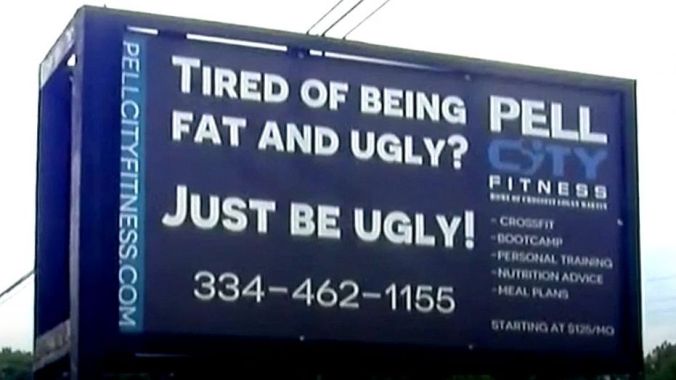
2. Funny! But…no, it’s just funny. Scott Campbell, the owner of the Pell City Fitness gym in Pell City, Alabama,  put up a sign that says “tired of being fat and ugly? Just be ugly!” City officials told him to take down the sign or be fined, saying it is too big and needs a permit, but other business owners told the local news media that they have never heard of the ordinance the city is citing being enforced. The suspicion is that Campbell is being singled out because some have complained that the sign is “insensitive.” No, it’s just funny…

This is the ethical problem with excessively restrictive laws, rules and regulations that are not consistently enforced. Prosecution can be used for ideological and partisan discrimination. Not only is the sign benign, it is not even original: that same language is on fitness company ads all over the country. So far, it looks like the community is supporting Pell and that the city will back down, but this is Alabama. Call me pessimistic, but I doubt the sign would be allowed to stand for long in Washington State or California if an ordinance could be found to justify pulling it down.

The First Amendment dies in increments. Continue reading →

THAT’S The Concept I Was Looking For—“Cultural Vandalism”!

Does he still seem like God to you?

“Cultural vandalism”!

Perfect! That’s the ideal description of what artists, especially performing artists, do when they engage in such revolting conduct that it becomes difficult or impossible for us to enjoy their work the way we could before we knew they were disgusting human beings.

We owe Vulture writer a debt of gratitude, not only for identifying the conduct as cultural vandalism (a term usually reserved for acts like stealing the Elgin Marbles), but also for explaining, in his article The Cultural Vandalism of Jeffrey Tambor, clearly and powerfully, why it is a serious ethical breach beyond the misconduct itself.

He writes in part,

Once I know something like this, it makes it impossible for me to look at the actor and not think of the horrible things they’ve allegedly done. I don’t care to argue whether this is rational or not (I think it is), or whether I hold inconsistent opinions of works that are problematic for whatever reason (everyone does). The repulsed feeling is still there, and it makes a difference in how I react as a spectator…This sort of thing seems categorically different from, say, watching a film starring an actor whose political beliefs are different from yours (though there, too, a line could be irrevocably crossed). Once you believe that a particular actor or filmmaker or screenwriter is a predator or abuser, you’re aware that the environment that produced your entertainment — the film set — was engaged in a conscious or reflexive cover-up, in the name of protecting an investment. You can still be passionately interested in the thing as a historical or aesthetic document — seeing it through the eyes of, say, an art historian who can contextualize Paul Gauguin within the totality of 19th-century painting, or an African-American studies professor who’s fascinated by Gone With the Wind — but you can’t lose yourself in it anymore. You can’t be in love with it. You can’t really enjoy it in the most basic sense, not without playing dumb.

You didn’t do that to the artist. The artist did that to himself…

And it’s awful. People’s lives get ruined, their careers get interrupted or destroyed. The emotional, physical, and financial damage that problematic artists inflict on people in their orbit should always be the first and main subject of discussion…On top of all that, we also have the collateral damage of cultural vandalism. Fun, meaningful, even great works that dozens or hundreds of people labored over, that built careers and fortunes and whole industries, become emotionally contaminated to the point where you can’t watch them anymore…. in recent years, an entire wing of African-American cultural history has been vaporized by the Bill Cosby allegations and his recent felony sexual-assault trial, including the most popular sitcom of the ’80s (The Cosby Show), some of the top-selling comedy albums of all time, the precursor to the R-rated buddy comedy genre (Uptown Saturday Night and its sequels), and the first Saturday morning cartoon with a predominantly black cast (Fat Albert and the Cosby Kids). Predators’ careers are getting raptured, as well they should be. But unfortunately — perhaps inevitably — their work is getting raptured along with it, imploding into dust as the culture moves on to things that aren’t as problematic (or that might have skeezy stuff going on behind the scenes that we don’t know about yet)….

…Nobody is stopping anyone from watching these works (though they’re no longer as easy to find, and you probably have to own a DVD player). We can still talk about them, study them, write about them, contextualize them. But the emotional connection has been severed. The work becomes archival. It loses its present-tense potency, something that significant or great works have always had the privilege of claiming in the past.

That’s all on the predators. It’s not on you. None of us asked for this.

Continue reading →

Giving Credit When Credit Is Overdue: The Great Paul Frees And The Untold Secret of “Some Like It Hot”

I’m going to reveal a secret.

Paul Frees certainly isn’t a secret, or shouldn’t be. You know Frees, even if you don’t know his name. He was a brilliant vocal talent who, like his better-known contemporary Mel Blanc (the voice of Bugs Bunny, et al.) was called “The Man of A Thousand Voices.” Frees was more versatile than Blanc, however, and more ubiquitous as well. He was the voice of Boris Badenov in the “Rocky and Bullwinkle” cartoons, as well as the voice of Santa Claus, Jack Frost and dozens of other characters in the Rankin-Bass animated specials that are still shown every Christmas.

Frees did a killer Orson Welles impression that was used is several films, and by Stan Freberg as the narration for his immortal comedy album, “Stan Freberg Presents The United States of America (Part I). He was the voice of both John and George in the Beatles’ animated TV show, and  Ludwig Von Drake for Disney. He recorded the “Ghost Host” of Disney’s Haunted Mansion ride; indeed, his voice turns up in many rides in the theme parks, including “Pirates of the Caribbean.” In commercials, he was Poppin’ Fresh, the Pillsbury Dough Boy;  Toucan Sam, the Fruit Loops mascot who sounded like Ronald Coleman for some reason; and Boo Berry, who was a spoof of Peter Lorre. His Peter Lorre imitation had been honed as a member of Spike Jones’ troop of musical maniacs, and his Lorre-rendition of “My Old Flame” is a highlight of “The Best of Spike Jones” album, which I play often to maintain my sense of humor in dark days…

None of that is the secret, however. Continue reading →

Blue Monday Ethics Warm-Up, 5/7/2018: Fake Brain Death, Horrible History, Bad Bills And Worse Journalism

It’s Monday!

1  In thousands of little ways...Insidious, biased, deceitful, distorted and unfair information is fed to the public by the news media, unflagged or corrected by editors, presented as legitimate punditry and journalism either intentionally to warp public opinion for leftward political gain, or out of pure incompetence, depending on how much one accepts Hanlon’s Razor. The little ones, like the tiny repetitive concussions that over time give NFL players brain disease, may be more insidious than the whoppers.

Here is a typical example. Progressive op-ed writer David Leonhardt concludes his column about how Amazon is a dastardly monopoly endangering his beloved book stores by writing,

“Once the country emerges from the Trump presidency, I hope we will have a government that takes monopolies seriously.”

It takes magnificent gall to lay the power of Amazon at Trump’s doorstep. The internet giant built its virtual monopoly to its current power on Obama’s watch, with a Justice Department that looked the other way. Why? I wonder if it had anything to do with the massive co0ntributions Amazon magnate Jeff Bezos sent the Democrats’ way, or the fact that his newspaper, The Washington Post, was a reliable cheer-leader for Obama through is entire administration. Never mind: Leonhardt’s editors allow him to mislead readers into believing that Amazon is being allowed to do its worst because of Donald Trump.

Oh…did you notice the conflict of interest disclaimer pointing out the Post-Bezos-Amazon connection for those readers who might want to know that the Times’ rival for national newspaper primacy is owned by Amazon’s CEO? Neither did I. Maybe when the Times emerges from its fake news and blatant partisanship stage, it will start taking ethics seriously.

2.  Today’s Fox News incompetence note. I literally stopped on Fox News for 45 seconds this morning, and heard a lovely, buxom, Fox blonde clone report this story by saying, “the boy was brain dead for two months, then woke up.” [The original typo had “bot” instead of boy. A good time was had by all]

No, you idiot. He was not brain dead at all, because when you are brain dead, you’re dead, and you don’t wake up.  Doctors may have thought he was brain dead. He may have seemed to be brain dead. But he wasn’t brain dead.

Fake news, and stupid news.

Fox News.

3. The logic of Hollywood anti-gun zealots in a horror movie. A decent horror move could be made about the San Jose Mystery House, where Winchester rifle heir Sarah Winchester built a maze of rooms and stairways to keep her personal demons at bay. “Winchester” isn’t it, because its mission was to bludgeon audiences for two hours with perhaps the silliest anti-gun message ever devised. You see,  rumors persisted while Sarah was alive that she was building rooms for all the ghosts of victims of her father-in-law Oliver Winchester’s repeating rifle to reside. Thus workmen claimed the site was haunted. “Inspired by real events,” as the film says (the “real events” being the sensational tabloid tales), “Winchester” posits that the ghost of a Confederate soldier whose two brothers were killed in the Civil War has returned to get revenge. Sarah is racked with guilt, because, she says, the Rebel muskets were no match for the North’s repeating rifles, and “they never gave them a chance.”

Yup, those are the rules in war, all right: always give the soldiers trying to kill you a chance. Later, all the angry victims of the evil Winchester come out to glare: Native American, children, suicides, slaves. Continue reading →