Morning Ethics Warm-Up, 9/12/17: Hurricane Reports, And Poor Charles M. Blow Needs A Vacation

Good morning.

1 There is supposedly a controversy regarding the on-the-spot hurricane reports: is it ethical for networks and news stations to place reporters and camera operators in mortal peril by having them scream into a mic while being buffeted by wind, rain and debris?

What’s the controversy? Of course it’s unethical. In addition to sending ridiculously mixed and self-contradictory messages—“I’m standing here in the storm telling citizens in the area that they shouldn’t be in the middle of this storm!”—it is also bad Ethics Chess. This stunt will continue until the first reporter is blown into a wall and sustains permanent brain damage, or is injured by a flying piece of debris that impales her, maims her, or cuts her in half. It is entirely predictable that this will happen eventually, and once it does, reporters will stop doing it. Why not stop this before a the inevitable tragedy occurs?

TV stations do it for ratings, that’s all. It’s great visual programming. It’s not necessary. Half the time, we can’t make out what the reporter is screaming, and what they are screaming is redundant and stating the obvious.

Apparently the first reporter to do this was Dan Rather.

Figures.

2. What is the mission of a pundit, a talking head, a columnist? It has to be—don’t you think?—to enlighten readers, to convey a constructive, useful analysis of complex issues, to reliably filter facts and controversies through a unique view-point without so completely tainting his or her output with bias that it actively misleads.

Yesterday New York Times columnist Charles Blow issued a column titled “Soul Survival in Trump’s Hell on Earth.” This was the apotheosis of the kinds of columns Blow has been writing almost exclusively now for months; at least I hope it’s that, for I can’t imagine where he goes from here. This column, like the others, is nothing, literally nothing, but a nearly fact free exposition on the theme, “I hate the President. I really do. I do so, so much. I know you do too, and if you don’t, I hate you too. ARRRGGGGHHH!”

The headline isn’t hyperbole; Blow, if he is to believed, really thinks Americans are living in Hell because Donald Trump is President. Not because there is a Great Depression hovering over the land, not because we are embroiled in a Civil War, or the existential threat of a world war, or the daily threat of an  international stand-off igniting into world-wide thermonuclear obliteration, but because a President was elected that offends the ideological and partisan sensitivities of Charles M. Blow.

Hell.

Seriously.

How can the New York Times continue to justify publishing the weekly primal screams of this pompous, doctrinaire, and now apparently deranged pundit? Exaggerating problems and pronouncing that we are all but doomed is not a service. It is harmful. The only readers who will be persuaded by a column like this are the ones who decide that something has to be done and that it’s time to build that bomb. Moreover, when a pundit reaches the stage that Blow has, where the simple act of a government not agreeing with his views and enacting policies that he does not favor launches him into hysteria, that pundit needs a vacation. Or maybe another career.

What are Blow’s arguments that justify his diagnosis that the United States is now Hell on Earth? Is it that a major party and its supporters have set out deliberately to undermine American institutions by rejecting a national election, seeking to remove an elected President by non-electoral means? Is it that the  international fumblings and ditherings of the previous administration are, as predicted, resulting in increased threats to the United States and the rest of the world? Is it that American journalism and its uniquely free news media, beyond question the app that makes democracy function, has now become, by its own abuses, so completely politicized and untrustworthy that it has become a threat to the nation, rather than its watchdog?

Nah, none of this appears to bother Blow at all; as far as I can detect, he approves of all of it. Here is his Bill of Biased Generalities that add up to Hell on Earth: Continue reading →

Morning Ethics Warm-Up, 9/10/17: A Creep Places A Bounty On Hillary’s Hair, And More….

GOOOD Morning.

1 My weekly assessment of anti-Trump mania based on the New York Times Sunday Review shows mostly petulant complaining. The front page is Trump-less, as is the second. After that respite,this issue is notable for some of the best illustrations yet of a journalistic phenomenon unique to Trump coverage, the “this is so horrible and sinister because it’s taking place under President Trump, even though it is neither unique nor noteworthy, being a condition that has existed for decades or even centuries.” Frank Bruni, for example, gets an entire page to tell us that White House aides who leave the Trump White House cash in, what Bruni calls “the ethos of enrichment.” You will be surprised, or maybe not, to learn that the essay about this new and venal trend under Trump never once mentions the name “Clinton,” the family that made cashing in on White house residency a family business, or do you have another theory why Chelsea Clinton is rich? You see, if Trump/Republicans/Conservatives do it, it’s disgusting because it’s Trump/Republicans/Conservatives doing it. What “it” happens to be doesn’t seem to matter much.

Then there is a “I can’t believe how stupid Trump supporters are” essay by NBC’s Katy Tur that contains this tell: “On election day they trusted his judgment more that they trusted any of us.” Wait: who’s the “us” that is being set up as opposition to a Presidential candidate, Katy? Journalists aren’t supposed to be telling citizens who to vote for, who is trustworthy or who will be a worthy leader. That statement is why so many voters don’t trust you, and also why they shouldn’t.

My favorite, though, a true classic in spin and how to present an issue in distorted terms to mislead the public, is a sob piece by a Yale grad student—yes, if you can write a sufficiently biased and critical essay about the plague that is the Trump administration, you don’t have to be a journalist. Your political biases are enough. In this case, the author is an illegal immigrant, as is every member of her family, so the Times believes that she is the perfect objective commentator on Trump policies regarding illegal immigration. Her theme: “Spreading fear is part of the administration’s plan.”

That plan is called law enforcement and deterrence. The government making life uncomfortable for law-breakers and ensuring that the guilty never feel comfy enough to think, “Well, the heat is off! They’ll never catch me now!” has been an uncontroversial and effective means of ensuring a safe and fair society for centuries. It was the Obama administration that endorsed the novel, bizarre and corrosive policy of telling illegal immigrants, “No problem: just make sure you don’t rape, kill or rob anyone, and you’re golden. Welcome!”

It is the indignation that comes through these essays that is so infuriating. How dare the government demand accountability for our law-breaking! tells us that her family has lived here illegally for 30 years.

If a newspaper is going to publish flagrantly manipulative junk like this, it would be responsible journalism to include a rebuttal along side it. Opinions are one thing; intentional distortions of the principles of civilization come unacceptably close to disinformation. Continue reading →

Morning Ethics Warm-Up, 9/1/17: Richard Simmons, Stilettos, A Sarcastic Cop, And The Post Sides With Palin

GOOD MORNING SEPTEMBER!

1.Good riddance to August, which had the worst fall-off in traffic here relative to the previous year of any month in Ethics Alarms history. I only have theories, the main one being that last August’s surge was an anomaly fueled by the Presidential campaign and the fact that Ethics Alarms was analyzing the ethics deficits of Hillary, Trump, the news media and both parties in roughly equal measure, since they were misbehaving in roughly equal measure.  Since “the resistance” and their allies in the news media, academia and elsewhere decided to reject democratic institutions like elections and the office of the Presidency in their revulsion, and mount a dangerous perpetual assault on the President with the objective of  undermining his leadership and having him removed extra-Constitutionally, the left-leaning end of the blog-reading pubic has become rigid and unyielding, and unable to tolerate even considering any position but their own. I’m seeing it on Facebook, every day. Their position is indefensible on the facts, so they find any critical analysis of their conduct and attitudes unpleasant. Then again, it could be because Google is burying my posts for being insufficiently politically correct, or because I suck.

2. Here’s a perfect example of the kind of ethics issue that only deserves Warm-Up status: Melania’s shoes as she boarded Air Force One on the way to  Houston.

(She was in sneakers when she landed, and was mocked for that, too.)

The New York Times and other Trump-Hate news sources actually thought this fashion choice by the ex-model was worthy of criticism. In Melania Trump, Off to Texas, Finds Herself on Thin Heels , Vanessa Friedman spend hundreds of words dissecting how the stilettos were “a symbol for what many see as the disconnect between the Trump administration and reality.” Apparently the First Lady broke the “No high heels when leaving a disaster” rule in the First Family Ethics Manual. Letter writer Dennis Donalson correctly chided the Times, writing in part,

The fact that she wore high heels when boarding a plane, regardless of her destination, is not newsworthy. Sometimes a cigar is just a cigar and shoes are just shoes, not “the go-to stand-in for more nuanced, complicated emotions and issues.” Give Melania, and us all, a break.

Dennis notwithstanding, I’ve decided stories like this are wonderful: they are smoking gun evidence for anyone who isn’t similarly deranged that the news media is so consumed with anti-Trump mania that it is literally unable to determine what is or isn’t fair, proportionate and reasonable coverage. If the Times thinks Melania’s shoes are such a big deal, no wonder it goes nuts over what the President says to the Boy Scouts…and no wonder it is no longer reasonable to accord such a paper any credibility or respect at all. Continue reading →

First Parmesan Cheese, An Now This: A Judge Bends Over Backwards To Let The New York Times Escape Its Abuse of Journalism Rights

Oh, we knew Palin had nothing to do with this wacko, but it sure felt good to stick it to her anyway…

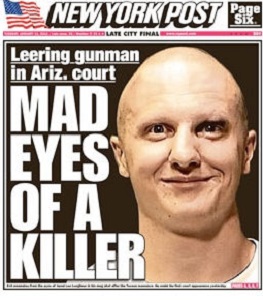
Federal judge Jed S. Rakoff  has dismissed Sarah Palin’s defamation lawsuit against The New York Times, ruling that she had failed to show that the Times  defamed her in its June editorial stating that she was responsible in part for the Tucson shooting of Rep. Gabrielle Giffords and others by the deranged Jared Loughner. Rakoff’s  ruling argued that the statements in the Times editorial were ambiguous (where have I heard this before?), and thus did not qualify as “provably false,” resulting in insufficient evidence that the Times had written the story with “actual malice.”

“[I]f political journalism is to achieve its constitutionally endorsed role of challenging the powerful, legal redress by a public figure must be limited to those cases where the public figure has a plausible factual basis for complaining that the mistake was made maliciously, that is, with knowledge it was false or with reckless disregard of its falsity,” Rakoff wrote.

Right. Except that to write what it did, the New York Times Editors had to be unaware of what the Times itself had reported regarding Palin’s alleged culpability for the shooting. The Times reported, in great detail at the time, that the claim that Palin’s website had inspired Loughner was completely without merit.

A newspaper’s editors impugning a public figure by blaming her for multiple murders and the attempted assassination of a Congresswoman without checking its own reporting doesn’t qualify as “reckless disregard of its falsity”? If that isn’t reckless disregard, what is? Continue reading →

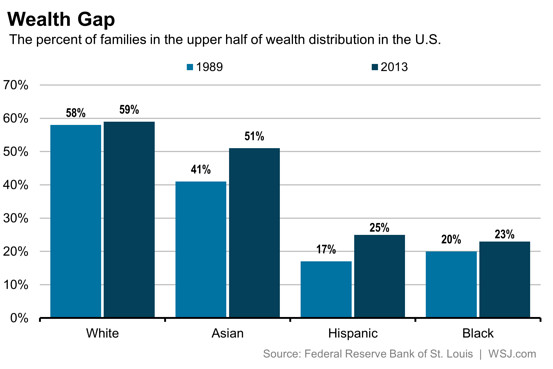
“Racial Wealth Gap Persists Despite Degree, Study Says”…Now What?

The story ran as the front page lead in the New York Times more than a week ago, and was promptly ignored as the more pressing matter of criticism Donald Trump’s erudition in condemning the violence in Charlottesville obsessed the media:

“The long-term trend is shockingly clear,” said William R. Emmons, an economist at the Federal Reserve Bank of St. Louis and one of the authors of the report. “White and Asian college grads do much better than their counterparts without college, while college-grad Hispanics and blacks do much worse proportionately.”

A college degree has long been recognized as a great equalizer, a path for minorities to help bridge the economic chasm that separates them from whites. But the report, scheduled to be released on Monday, raises troubling questions about the ability of a college education to narrow the racial and ethnic wealth gap.

“Higher education alone cannot level the playing field,” the report concludes.

Great. What will level the playing field, and if the only solutions are ethically flawed, can the nation ethically accept that the playing field cannot be leveled? Is it necessary that all races achieve identical levels of success? Does the fact that a race, or an ethnic group, either exceeds or falls short of statistical parity signal that draconian measures must be undertaken by the government? Are we really committed to results based policies, or opportunity-based policies?

In the Times print version, there was a chart that labelled, among other things, Asian families as “over-represented” among wealthyl households headed by a college grad. “Over-represented” is a provocative word, suggesting that something is wrong with Asian American achieving beyond what pure statistical analysis would predict. Is it so unimaginable that the group itself may have something to do with its success—that its culture and values may allow it to be “over-represented”?

No, it isn’t unimaginable, but it is inconvenient and politically explosive. If culture and values can explain over-achievement, it will be difficult to avoid the conclusion that culture and values also play a part in under-achievement as well. The Times report (I haven’t read the whole study)  doesn’t hint at such a conclusion, while citing many other potential causes:

Researchers have repeatedly found discrimination in the job market. When two nearly identical résumés are sent out, for example, it has been documented that the candidate with a white-sounding name receives more callbacks than the applicant with a black-sounding name.

Discrimination like this and other factors contribute to the persistent and substantial pay gap between whites and minorities. Blacks, for instance, hold a disproportionate share of government jobs — a sector that has shrunk in recent years and provides fewer opportunities for big wage gains. Blacks have fewer advanced degrees, and the ones who do are more often in lower-paying fields or graduates of colleges with lesser reputations.

“Blacks and Latinos at all education levels, including college and advanced degrees, earn less than their white counterparts, which means lower lifetime earnings” and less ability to save, said John Schmitt, research director at the Washington Center for Equitable Growth, who reviewed an advance copy of the report.

Blacks and Hispanics are also less likely than whites to inherit money or receive help from their parents to cover a tuition bill or a down payment on a house.

William A. Darity Jr., a professor of public policy at the Samuel DuBois Cook Center on Social Equity at Duke University, points out that a family headed by a black college graduate has less wealth on average than a family headed by a white high school dropout.

That last fact is especially discouraging.

The relative disinterest of the news media in the implications of the report is troubling, or perhaps I should say its disinterest in pursuing an open and honest discussion of what the implications are, and what new policies should be considered. The status quo, with historically oppressed and disadvantaged groups perpetually lagging behind and perpetually blaming white society for their persistent plight, is a recipe for chaos, generating shrill and divisive prescriptions like this one, from Chanelle Helm,  a Black Lives Matters leader in Louisville:

Some things I’m thinking about that should change (in that Southern, black grandmama voice):

1. White people, if you don’t have any descendants, will your property to a black or brown family. Preferably one that lives in generational poverty.

2. White people, if you’re inheriting property you intend to sell upon acceptance, give it to a black or brown family. You’re bound to make that money in some other white privileged way.

3. If you are a developer or realty owner of multi-family housing, build a sustainable complex in a black or brown blighted neighborhood and let black and brown people live in it for free.

4. White people, if you can afford to downsize, give up the home you own to a black or brown family. Preferably a family from generational poverty.

5. White people, if any of the people you intend to leave your property to are racists assholes, change the will, and will your property to a black or brown family. Preferably a family from generational poverty.

6. White people, re-budget your monthly so you can donate to black funds for land purchasing.

7. White people, especially white women (because this is yaw specialty — Nosey Jenny and Meddling Kathy), get a racist fired. Yaw know what the fuck they be saying. You are complicit when you ignore them. Get your boss fired cause they racist too.

8. Backing up No. 7, this should be easy but all those sheetless Klan, Nazi’s and Other lil’ dick-white men will all be returning to work. Get they ass fired. Call the police even: they look suspicious.

9. OK, backing up No. 8, if any white person at your work, or as you enter in spaces and you overhear a white person praising the actions from yesterday, first, get a pic. Get their name and more info. Hell, find out where they work — Get Them Fired. But certainly address them, and, if you need to, you got hands: use them.

10. Commit to two things: Fighting white supremacy where and how you can (this doesn’t mean taking up knitting, unless you’re making scarves for black and brown kids in need), and funding black and brown people and their work.

I read this, and find myself wondering if one of the reasons for that discouraging study’s results is the increasing influence of voices like Chanelle Helm’s.

Morning Ethics Warm-up: 8/16/17

GOOD MORNING!

1. I’m heading to Boston and Fenway Park in a few hours to meet with two of my high school classmates and together pay our respects to the 1967 Boston Red Sox, the spiritual beginning of Red Sox Nation, and a group of men, then barely more than boys, who had as profound an effect on my life and view of it as anything I have ever experienced.

It’s the 50th Anniversary of that amazing team and the heart-stopping pennant race it won against all odds, in a four team race that came down to the final game of the regular season. I mean heart-stopping literally: the team wasn’t called “The Cardiac Kids” for nothing. TWO of my father’s colleagues at the Boston Five Savings Bank died of heart attacks while attending Red Sox games, during one of the 9th inning desperation rallies for which the team was famous. The only reason I didn’t perish in like fashion is because I was just 16 years old.

Why was this team, and that summer 50 years ago, so important to me? I don’t have time or space to answer that question well, and you’d probably wonder what I was babbling on about anyway. A 2017 film by Major League Baseball called “The Impossible Dream” does a fair job of explaining it, but it’s too short to do the job right.

I had listened to, watched or attended every Boston Red Sox game for five years, as the team lost and lost. From those bad teams, followed weakly by the city in those days, in a crumbling old park that seemed destined to be abandoned and torn down, I learned that winning wasn’t everything, that loyalty wasn’t easy, that Hemingway was right, and that baseball was about courage, humility, perseverance, doing your job every day, sacrifice, and hope, as well as usually losing at the end. That summer of 1967 taught me that hope is worth the effort even though hope is usually dashed by the ice water of reality, that you should never give up, that miracles do happen, and that nothing is as wonderful as when a community is united in a single, inspirational goal, no matter what that goal might be…and that you should never be afraid to give everything you have in pursuit of a mission, even when it is likely that you will fail.

I learned difficult, discouraging lessons, too. When an errant pitch hit Red Sox right-fielder Tony Conigliaro in the face on August 18, 1967, it was the beginning of a lesson that revealed its tragic last chapter 23 years later. That one taught me that life is horribly, frightening unpredictable, and that we envy others at our peril. It taught me that we need to do what we can to accomplish as much good as we can as quickly as we can, because we may lose our chance forever at any moment.

Tony C, as he was and is known as, was a beautiful, charismatic, local kid, the idol of Boston’s huge Italian-American community,  in his fourth season with his home town team at the age of 22. He dated movie stars; he recorded pop songs; he had a natural flair of the dramatic, and was destined for the Hall of Fame. One pitch took it all away. Although he had two comebacks and played two full seasons facing major league fastballs with a hole in his retina and his field of vision, Tony was never the same. After his final attempt to keep playing failed at the age of 30, he became a broadcaster, and at 37 was seemingly on the way to stardom again in 1982 when he suffered a massive, inexplicable heart attack—Tony  did not smoke, and had no family history of heart problems– that left him brain damaged until his death in 1990.

As Henry Wiggin, the star pitcher protagonist of the novel, play and movie “Bang the Drum Slowly” observes as he  reflects on the death of his catcher and roommate, everyone is dying, and we have to remember to be good to each other. But it’s so hard. Ethics is hard. The ethics alarms ring faintly when we are about the task of living, or not at all…

At the end of the story, the narrator, the best friend of the catcher (but not really that close a friend) recalls how quickly everyone on the baseball team went back to their selfish ways after their teammate went home to die Even the narrator, who was the leader of the effort to make the catcher feel loved and appreciated in his last days, ruefully recalls his own failing. The catcher had asked him a favor, just to send him a World Series program (the team won the pennant after he had become too ill to play), and he had forgotten to mail it until it was too late. How hard would it have been, the narrator rebukes himself, to just put it in an envelope and mail it? Why are we like that, he wonders?

1967 was the beginning of my exploration of that mystery too.

So I am going to Boston for the 30 minute ceremony. I can’t even stay for the game; I have a seminar to teach tomorrow morning, and the last flight out of Logan is at 9 PM. There will probably be just a small contingent from the Cardiac Kids: most of them are dead now, or too infirm even to walk onto the field. But Yaz will be there, and Gentleman Jim Lonborg; Rico Petrocelli, Mike Andrews, and maybe even Hawk Harrelson  and Reggie Smith. I will be there to say thank-you, that’s all.

And to show that I remember. Continue reading →

Morning Ethics Warm-Up: 8/9/2017

Good Morning!

1. On the matter of whether James Demore’s Google memo was unethical in its distribution, which some commenters here dispute, apparently he took the precaution of hiring an employment lawyer before he sent the memo. This strongly suggests that he was not merely opening up an internal discussion, but intentionally provoking a confrontation. If he just wanted to alert management to a problem, the ethical approach was to speak directly to management, not put out an e-mail that he had to know someone would leak to the internet.

Meanwhile, Google’s firing Demore for politely raising legitimate culture issues belies its “Don’t Be Evil” motto. It also may be illegal: Federal labor law bars union AND non-union employers alike from punishing an employee for communicating with fellow employees about improving working conditions. California also has a very strong anti-political discrimination law which “prohibits employers from threatening to fire employees to get them to adopt or refrain from adopting a particular political course of action.”

2. I noted this in yesterday’s post, but it’s worse than I thought: the left-wing news media, which is to say the news-media, has displayed neither discipline, common sense (you can’t keep signalling how biased you are, guys—eventually people will notice) nor ethical journalism by outrageously misrepresenting the message and the tone of the memo. CNN’s Brooke Baldwin, for example, described the memo as saying  “I don’t really like women anywhere near a computer.” That’s false reporting. Do these people understand that anyone can read the memo and see that either they are lying, or haven’t read the memo?

3. The memo’s allegedly “controversial” statement that men and women have some innate physiological, emotional and psychological differences that make their genders (in general, not in specific cases) better or less-well-suited for certain jobs, tasks or fields takes me back to my multiple battles with feminists who insisted that I cast female actors in “Twelve Angry Men.” They simply put their fingers in their ears and hummed when I pointed out that the play was about the group dynamics when twelve disparate male strangers are locked in a room. Do women in such a situation keep threatening each other physically? I think not. Actually, the play is an advertisement for diversity: having women in that largely dysfunctional fictional jury would have probably solved many of its problems, but because women are different from men, not because they are exactly the same, as the Georgetown feminists insisted. Women really need to decide what their stand is: are they different in ways that can be advantageous, or not different at all? They can’t have it both ways. On Instapundit, Glenn Reynolds recalled “The Althouse Rule of Gender Research”, which is, : “Scientists: remember to portray whatever you find to be true of women as superior.”

This goes for commentators, pundits, journalists, educators and, of course, Presidential candidates. ‘We need a woman in the White House (because men screw things up)’ is wise and true, and not sexist at all. Continue reading →

Unethical Op-Ed Of The Month: “Don’t Weaken Title IX Campus Sex Assault Policies” (The New York Times)

Do you know what this monstrosity of an op-ed finds outrageous about Betsey DeVos’s efforts to undue the Obama administration’s “guilty unless proven innocent”  standard for campus rape allegations?  It involves too much due process, as in basic fairness before a citizen is grievously punished and harmed by the determination that he or she has committed a crime.. The authors, Jon Krakauer and Laura L. Dunn, put it this way:

Damn right it does. Before someone is punished for a vile crime like rape or sexual assault, the accuser’s credibility and motives must be established. Astonishingly, with all the horrific examples of men being falsely accused of rape, like here, here, and here, the campus activists, feminists, progressives and the social justice warriors continue to insist that any female accuser should be presumed to be a victim, meaning that the accused is de facto presumed to be guilty.

“Sex-crime trials, like all criminal proceedings, set an extremely high bar for conviction to diminish the chance that an innocent person will be unjustly incarcerated. In contrast, the harshest penalty a university can inflict in a Title IX hearing is expulsion, an outcome that does not demand such a stringent burden of proof. In these hearings, neither party is favored, and by leveling the procedural playing field, Title IX makes it more likely that students will report sexual violence.”

The problem with this supposed fairness of “neither party is favored” is that for one party, there are no negative consequences of an insufficiently-supported accusation being rejected. For the individual accused, the stakes are far greater, life altering and potentially dire. More:

“Whenever a student is accused of sexual assault, university administrators need to render their judgment with tremendous care, because erroneously determining that a student is responsible for sexual misconduct can cause lasting harm. But just as much care needs to be taken to make sure that students who commit sexual assault are not let off the hook.”

In other words, the ends justify the means. This is the same mindset expressed in 2015 by Democratic Congressman  Jared Polis, at a congressional hearing on campus sexual assault. 

He said, earning him an Unethical Quote and an Incompetent Elected Official designation on Ethics Alarms,

“If there’s 10 people that have been accused and under a reasonable likelihood standard maybe one or two did it, seems better to get rid of all 10 people. We’re not talking about depriving them of life or liberty, we’re talking about their transfer to another university.”

Krakauer and  Dunn similarly shrug off the consequences to a young man of being falsely tarred as a rapist and kicked out of school: it’s not like staying in the college you enrolled in is a right. Like Polis, they pretend that there are minimal adverse life consequences from being branded a rapist. Continue reading →

UPDATE: So THAT’S What Really Is Going On. Boy, Wouldn’t It Be Great If There Was Some Trustworthy Professional Source That Would Report Events Without Spin And Intentional Distortions?


Somehow, I expect the New York Times to be better than this.

Today’s Morning Warm-Up included this item as its final note:

Ethics Alarms will certainly feature more on this development, but for now I’ll just welcome the decision, sure to be attacked as “white supremacy,”  by the Justice Department’s civil rights division to begin  investigating and suing universities over affirmative action admissions policies deemed to discriminate against white applicants. Affirmative action has always been a euphemism for “race-based discrimination in favor of the right race,” and while it can be argued that it was a necessary evil in the wake of Jim Crow, it is still a hypocritical and unconstitutional policy.  I hope the Justice Department includes discrimination against Asian-American students in its crackdown as well.

Well what do you know?

DOJ spokeswoman Sarah Isgur Flores  put out a statement today clarifying what the New York Times went out of its way to distort, saying,

“Press reports regarding the personnel posting in the Civil Rights Division have been inaccurate. The posting sought volunteers to investigate one administrative complaint filed by a coalition of 64 Asian-American associations in May 2015 that the prior Administration left unresolved. The complaint alleges racial discrimination against Asian Americans in a university’s admissions policy and practices.”

This was the 2015 complaint by Asian-Americans claiming they were victimized by quotas at Ivy League schools that was discussed in the Ethics Alarms post I linked to this morning. Continue reading →

Debbie Wasserman Schultz And Her Shady Pakistani Tech

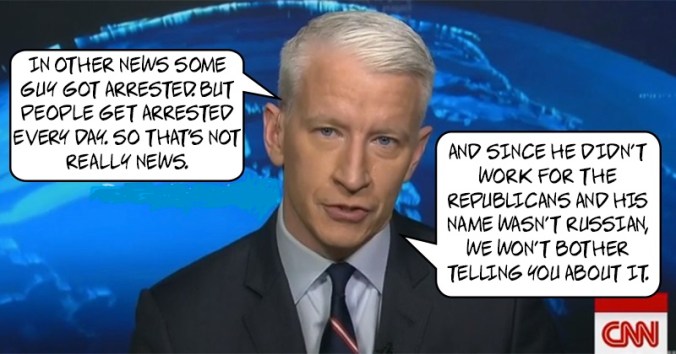
Obviously, this is not true. In fact, Anderson didn’t mention the story at all….

While the Trump-stalking pro-“resistance” news media has been lightning-quick to pounce on any whiff of suspicion emanating from everything from a botched opposition research attempt by the President’s idiot son, to a “secret” meeting between the President and Putin that was in plain view. to a shockingly friendly letter to the President from a 9-year-old, it has been strangely incurious about this story, which to the non Trump-deranged is belching more smoke than any two “scandals” being investigated by the special counsel. No headlines, no segments on the broadcast news, except for Fox, of course. I haven’t written about it because it’s difficult to find sources other than Fox and Breitbart to rely on. I’m still unsure what exactly it all means

Up to the moment he was arrested for bank fraud as he attempted to leave the country for Pakistan,  Imran Awan was being paid by Rep. Debbie Wasserman Schultz, former chair of the Democratic National Committee, former Hillary Clinton campaign staffer (added immediately and shamelessly after having to resign after being revealed as leading the rigging of the nomination against Bernie Sanders and for Hillary), and hilariously dishonest spinner for Barack Obama for eight years, as her trusted IT guy. Well, as her IT guy, anyway.

Aswan’s wife, Hina Alvi, also in the family business of being paid by Democrats, had already fled the country with her three young daughters. The Awans  had snagged a fraudulent $165,000 loan  from the Congressional Federal Credit Union, and sent it home to Pakistan. Aswan’s position with the DNC and Wasserman-Schultz had given him and other nefarious collaborators—his relatives!— in various Hill IT department years of access to the e-mails and electronic files of members of the House’s Intelligence and Foreign Affairs Committees. They were accessing members’ computers without their knowledge, transferring files to remote servers, and stealing computer equipment, including hard drives.

The Democrats fired all of the Awans early this year, except, oddly, for Awan himself, who stayed on Debbie’s staff, collecting a heft salary.  She kept him in a place that allowed  access to the work product and communications of members of  United States Congress right up until he was arrested.

What does this mean? We don’t know yet, and the news media is acting as if it doesn’t want to know. Asks Andrew McCarthy, Continue reading →