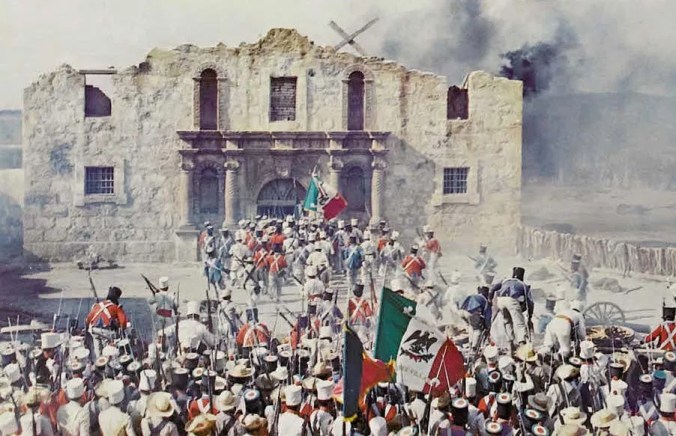
Before we bid the Alamo goodbye for another year (in which there was virtually no mention of the event in the media, despite the obvious parallels with Ukraine’s plight), I have a few ethics observations on the 1960 John Wayne film, some of which I may have offered before:
- The version on Amazon Prime is unfair to the movie, cutting out almost half an hour from the version that was originally released. The film was an epic and produced to be one, complete with an overture and an intermission. These should be restored. Some of the cuts aren’t missed, like the irrelevant and sentimental birthday party for Capt. Dickinson’s daughter (played by Wayne’s own daughter) along with the sappy song Ken Curtis sings to her. Still, it’s an important movie, and deserves more respect. The parson’s death scene is a particularly cruel cut.
- The film is perhaps the perfect embodiment of the lesson of another Wayne film, “The Man Who Shot Liberty Valance”: “When the legend becomes fact, print the legend.” In virtually every instance where the screenplay had to choose between the actual events and the myths as the Alamo tale has been told through the years, it was the myth that won out. There is a justification for that. The Alamo is a symbol of bravery, sacrifice, continuing to fight against hopeless odds, and the American spirit. That’s what John Wayne wanted to make a film about, not history. As one Texas historian said in a documentary, “The movie is wrong about almost everything, but it feels right.” In this it resembles the current debate over how to teach American history to children.
- Wayne’s carelessness (or inexperience) as a director occasionally hurts the film, like when Chill Wills accompanies himself on the guitar and it’s obvious that he isn’t even trying to look like he’s playing it. I’m not a stickler for accents, but it also annoys me that Laurence Harvey uses a Southern drawl in his first scene, and speaks like the very British actor he was for the rest of the movie. On the other hand, Wayne’s direction of the final night before the slaughter is excellent and moving.
- The movie went to great lengths to avoid denigrating Mexicans. There is an exchange where they Alamo defenders express their admiration for their enemies’ courage, and Wayne shows weeping Mexican women tending to the fallen troops.
- The screenplay includes an Al Sharpton-style ploy by Davy Crockett. To convince his Tennesseans to join the Alamo cause, he creates a fake letter from Santa Anna, to Crockett, warning him and his men not to involve themselves in the fight, and threatening their lives if they do. As Crockett assumed, his men take offense and resolve to join the fight simply to defy the Mexican general. Davy admits that he wrote the letter, and is amazed that this doesn’t change their reaction at all. After all, they insist, Santa Anna would have made such a threat, so the letter might as well be true! Shades of Tawana Brawley…