Education
Here Is Why Baseball Fans, And Almost Everyone Else, Are Ignorant Of How The Law Works…

Last night, while I was watching a lousy Red Sox loss to the Oakland A’s, the Boston broadcasters announced their mid-game poll: “Do you agree with the Supreme Court decision on sports betting?” Viewers were supposed to text one number for yes, another for no. It was quite clear that the Sox announcers themselves had no clue what the decision was, however, as Jerry Remy and Dave O’Brien began debating the pros and cons of legalizing sports betting. The debate was edifying, but had nothing to do with the Court’s decision in Murphy v. National Collegiate Athletic Association whatsoever.
They and thousands of Red Sox fans had no clue what the decision was, and their ignorance didn’t stop them from voting on what they thought it was. What they thought it was came from second and third hand social media posts, and misleading headlines (“Supreme Court Strikes Down Anti-Sports Betting Law”) as well as brain-dead reports on the meaning of the majority ruling. (“Today the Supreme Court opened the door to legalized sports betting by declaring the federal law banning it unconstitutional…”). On a local news channel in the D.C. area, a reporter was dispatched to “investigate” if the reporting on the decision was accurate. “We began by reading the decision itself,” he said,
Wow! What a concept! Read the opinion rather than depend on ignorant reporters who don’t know the Constitution from “Hiawatha” to explain it based on what they think they know, which is not remotely like knowing anything!
Quoting again from ScotusBlog, here’s what “the decision on sports betting” was…
The 10th Amendment provides that, if the Constitution does not either give a power to the federal government or take that power away from the states, that power is reserved for the states or the people themselves. The Supreme Court has long interpreted this provision to bar the federal government from “commandeering” the states to enforce federal laws or policies. [The] justices ruled that a federal law that bars states from legalizing sports betting violates the anti-commandeering doctrine…
…In a decision by Justice Samuel Alito, the court began by explaining that the “anticommandeering doctrine may sound arcane, but it is simply the expression of a fundamental structural decision incorporated into the Constitution” – “the decision to withhold from Congress the power to issue orders directly to the States.” And that, the majority continued, is exactly the problem with the provision of PASPA that the state challenged, which bars states from authorizing sports gambling: It “unequivocally dictates what a state legislature may and may not do.” “It is as if,” the majority suggested, “federal officers were installed in state legislative chambers and were armed with the authority to stop legislators from voting on any offending proposals. A more direct affront to state sovereignty,” Alito concluded, “is not easy to imagine.”
Later on, Alito makes it clear that the decision isn’t pro-sports betting or anti-sports betting. The decision is anti-the federal government telling the states that they can’t pass certain kinds of laws, and the subject matter of those laws are irrelevant to that principle. The decision in Murphy v. National Collegiate Athletic Association no more approves legalized sports betting than it approves speed limits over 90 or letting felons vote in state elections. The decision says that while the federal government can pass its own laws, it can’t order the states not to pass laws.
Never mind! Thousands of Red Sox fans had opinions based on misunderstanding the decision, just as many bloggers and online commenters worked themselves into a frenzy about the evils or benefits of sports betting, aided by journalists who literally, not figuratively, didn’t know what they were writing about, and didn’t have the integrity or common sense to find out.
Good job, everybody!
An Ethics Riddle: What Do Starbucks And The University Of Virginia Have In Common?

They both called the cops on someone who was violating a policy. Only one of them, however, was accused of racism.
Bruce Kothmann, a University of Virginia alumnus, read aloud from his Bible on the steps of the school’s Rotunda this week, so university police came make him stop. He did stop, because he didn’t want to be arrested. For such public speech is no longer allowed at the public university. The Rotunda is not one of the places the university has designated for public speech by outsiders. Kothmann was on to campus because his daughter had just finished her sophomore year, but was reading from his Bible with him to challenge the school’s policy limiting speech on campus.
A terse reader comment on the story said, “This is basically what happened at Starbucks.” The comment is correct.
Would UVA have sent the police to silence a black parent? My guess: no, and if it had, the school would be grovelling in the dust right now, begging for forgiveness. Unless the school could quickly point to a white transgressor who got the cops called on him, a charge of race bias would be devastating, and, of course, effective.
You recall the Starbucks episode: I covered it here. Two African Americans were informed of a Starbucks policy that required those using the facilities to be customers. The men refused, the manager called the police claiming trespass, and the rest is ugly, race-baiting history. The two men could have left just as Mr. Kothmann agreed to stop reading, but that’s just moral luck. The reader was right: the episodes were the same….except for the race of the violator involved.
The Ethics Alarms position is that both policies, that of the university and the old Starbucks policy, are reasonable, with the Starbucks policy being the more defensible, since UVA is a public university and has the First Amendment to contend with. Never mind: the news media and the social justice social media mob have little interest in a white man being stopped by police from reading that old rag, The Bible, but if two black men violating a private business’s reasonable policy have that policy enforced against them, that’s intolerable.
We have the birth of a new racial privilege, now extending beyond police shootings (a white cop can safety shoot a threatening white suspect, but not a black one) to other forms of previously justifiable conduct. Continue reading
Ethics Quiz: The Child-Molesting Pitcher

Luke Heimlich is a rising college baseball star pitcher at Oregon State, and may well have a future in Major League Baseball. There is a problem though: Heimlich, 22, pleaded guilty to sexually molesting his 6-year-old niece when he was 15 years old. The further complication: he denies that he committed the crime, which was not just one incident but a pattern over two years. He told The New York Times that he only pleaded guilty to ” for the sake of family relations.” “Nothing ever happened,” he told the paper. The girl’s mother, however, says there is no question that he was guilty.
I’m tempted to say that it’s no wonder he pleaded guilty when he was 16. One of the charges was dropped and he was placed on two years’ probation, took court-ordered classes and had to register for five years as a Level 1 sex offender, which in the state of Washington means a low risk to the community. He had to write a letter apologizing to his niece. After five years, the records were expunged and he no longer has to register as a sex offender. What a deal!
Last year story was broken by the newsmedia, and now there is a controversy over whether Heinlich should be allowed to play college baseball. Brenda Tracy, a victims’ rights activists, asked the Times,
“What kind of message does that send our kids?” she asked. “We have now normalized this behavior. The feeling at Oregon State right now is that our team is winning, so they’ve moved on. What does that say to the little girl in this case? What does it say to all survivors?”
Then there is my concern: what does it say about this man’s character that he pleaded guilty to get a lenient deal, and now blandly says that he was lying? I’d view him as more trustworthy if he admitted the crime, was remorseful and repentant, and accepted responsibility. If he did molest the girl, and still denies it, one can hardly say that he has been rehabilitated.
Your Ethics Alarms Ethics Quiz of the Day:
Should Luke Heimlich be allowed to play college baseball?
I’d like to see the polling on this…
Morning Ethics Warm-Up, 5/8/2018: George Washington, Elaine Chao, Brown-Haired Fox News Babes And Clumsy Cheerleaders

Good Morning!
1. Diversity at Fox News! There was a brunette co-anchor sitting with Bill Hemmer this morning. I almost spit out my coffee, Now if the network would only hire a female newsreader who wouldn’t be a credible contestant in a beauty pageant, the culture might advance a bit…
2. Can an employer refuse to hire an asshole? The NFL Players Association has filed a grievance on behalf of free-agent safety Eric Reid, alleging collusion that has denied him a job for the upcoming 2018 season, and arguing that no NFL rule mandates players stand during the playing of the national anthem, that the league has indicated it respects “the rights of players to demonstrate,” and the collective bargaining agreement states “league rules supersede club rules.”
The grievance loses, or the NFL is in big trouble. Well, it is already in trouble, but more trouble. Demonstrating players annoys fans and hurts business. The NFL may force teams to allow jerks like Reid and ex-player Colin Kaepernick to interfere with Sunday head-bashing frolic by imposing their half-baked politics on the proceedings, but team can certainly choose to pay million dollar contracts to players who have better judgment, and are thus more trustworthy employees.
3. At George Washington University, it’s The Political Correctness Morons vs. The Conflict-Averse Spineless! I can’t believe I’m writing this. No, of course I can: I’ve predicted it.
The following on-line petition has garnered the requisite number of signatures among George Washington University students, and now will get an official response:
“We, as students of the George Washington University, believe it is of great exigence that the University changes its official mascot. The use of “Colonials,” no matter how innocent the intention, is received as extremely offensive by not only students of the University, but the nation and world at large. The historically, negatively-charged figure of Colonials has too deep a connection to colonization and glorifies the act of systemic oppression. Alternative nickname recommendations are “Hippos,” “Revolutionaries”, or “Riverhorses.”
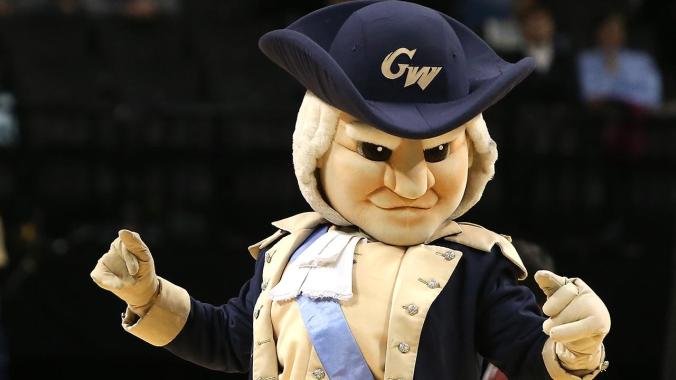
They apparently don’t teach American history at GW. The nickname for the athletic teams is “The Colonials” because the United States, prior to its liberation, were called “the Colonies,” because they were colonies. Colonials are those who have been colonized, not those who do the colonizing. The mascot, meanwhile, is called “George,” because he is a caricature of George Washington, who led the Colonials to victory over Great Britain, and anyone who can’t puzzle that out shouldn’t be in college.
The petition represents the mutant offspring of a one night stand between The Confederate Statuary Ethics Train Wreck and The Niggardly Principles.
Who will win? Oh, the Morons, probably. On campuses the Morons almost always defeat the spineless administrators, as well as common sense and rationality. [Pointer: Res Ipsa Loquitur]
Oh…here’s George:
4. Speaking of spineless…The cheerleading coaches at Hanover Park High School in New Jersey decided that there would be no more try-outs for the squad. The school’s athletic director said that after a single mother complained about her daughter not making the cut, the policy would be changed in favor of “inclusion.” The school board released a statement saying: Continue reading
Morning Ethics Warm-Up, 5/5/2018: “Why We Can’t Have Nice Things” Edition

Good Morning!
(I’m happy to report that my Clarence Darrow ethics program for a lawyer group yesterday in Annapolis was received wonderfully, in no small part due to actor Paul Morella’s moving and powerful recreations of Darrow’s courtroom oratory. As is often the case, attendees said that they didn’t realize a legal ethics presentation could be so interesting. If fact, there is no excuse for any kind of ethics NOT being interesting…)
1. I call this “cultural defacing.” At 10:30 last night, I watched the end of “The Princess Bride,” and was thrilled to arrive just as the final showdown between Ingo Montoya (Mandy Patinkin) and Count Rugen (Christopher Guest). Here is the scene, a classic one, which begins with the Count apparently fatally wounding Inigo with a dagger:
Inigo Montoya: Hello, my name is Inigo Montoya. You killed my father. Prepare to die.
[Inigo advances on Rugen, but stumbles into the table with sudden pain. Rugen attacks, but Inigo parries and rises to his feet again]
Inigo Montoya: Hello, my name is Inigo Montoya. You killed my father. Prepare to die.
[Rugen attacks again, Inigo parries more fiercely, gaining strength]
Inigo Montoya: Hello! My name is Inigo Montoya! You killed my father! Prepare to die!
Count Rugen: Stop saying that!
[Rugen attacks, twice. Inigo avoids and wounds Rugen in both shoulders. Inigo attacks, bellowing:]
Inigo Montoya: HELLO! MY NAME IS INIGO MONTOYA! YOU KILLED MY FATHER! PREPARE TO DIE!
[Inigo corners Count Rugen, knocks his sword aside, and slashes his cheek, giving him a scar just like Inigo’s]
Inigo Montoya: Offer me money.
Count Rugen: Yes!
Inigo Montoya: Power, too, promise me that.
[He slashes his other cheek]
Count Rugen: All that I have and more. Please…
Inigo Montoya: Offer me anything I ask for.
Count Rugen: Anything you want…
[Rugen knocks Inigo’s sword aside and lunges. But Inigo traps his arm and aims his sword at Rugen’s stomach]
Inigo Montoya: I want my father back, you son of a bitch!
[He runs Count Rugen through and shoves him back against the table. Rugen falls to the floor, dead]
Except “you son of a bitch” was cut!
We settled this when the TV showing of “Gone With The Wind” let Clark Gable’s iconic exit line, “Frankly my dear, I don’t give a damn” remain uncensored, and later,when John Wayne as Rooster Cogburn uttered the words, “Fill your hand, you son of a bitch!” before charging Ned Pepper and his gang. It is unfair and disrespectful to wreck the best work of writers and actors for the few remaining people on earth who take to their fainting couches when rude language meets their ears. You don’t edit Rhett, or Rooster, or Inigo, or even John McLane when he says, “Yippee ki yay, mother fucker!” Show the movie, or don’t show the movie, but don’t ruin the movie for the most easily offended in the audience. Continue reading
“Cultural Appropriation” Indoctrination From Gonzaga University

From Campus Reform, one of two useful websites that peers into the sick culture of many indoctrinating left-wing educational institutions (the other is Campus Reform) comes the release of this jaw-dropping memo sent to students at Gonzaga University:

That Facebook entry links to a website listing “6 Ways To Celebrate Cinco de Mayo Without Appropriating The Mexican Culture.” The Gonzaga Facebook page includes a graphic with such advice as “don’t you dare put on that ‘sombrero,’” “acknowledge the stereotypes you have internalized and discover why they are problematic,” ““donate to organizations working for immigrant rights,” and “support AUTHENTIC Mexican businesses,” although “CHIPOTLE DOESN’T COUNT.” “Try a family-owned restaurant run by actual Mexican people (They have better food anyway. We promise.),” the graphic says. “Maybe even enjoy some authentic Mexican music.”
My immediate reaction to this ham-handed, bigoted message would be, after the obligatory “Bite me!,” to have lunch at Taco Bell, pull out those old Bill Dana comedy albums, and to watch “The Three Amigos.” Oh, and I will put on a sombrero (I own a great one, as well as an authentic Sioux headdress, three cowboy hats, a fez, a Viking helmet (not so authentic), a beret, and Kaiser Wilhelm helmet, and a jester’s cap), because I will wear anything on my bald head that I goddamn please, and if my attire offends someone, that’s their problem. I don’t wear any of those costume pieces as insults, and as a member of the world community, I will borrow, honor, emulate and appropriate whatever part of it that appeals to me. For I am a free citizen of the United States of America, and don’t order me to express myself as you would prefer. Continue reading
Morning Ethics Warm-Up, 5/4/2018: White Artists, Black Artists, Brain Damage And The Mad Midnight Pooper

Good Morning!
(On the way to lovely Annapolis, MD to present my Clarence Darrow legal ethics program, along with D.C. actor Paul Morella, the real star of the day and the best Clarence Darrow portrayer alive. Paul starred in my 2000 original one-man show about the iconic lawyer-rogue, and has been performing it for lawyer groups and bar associations ever since.)
1 Déjà vu! I would write a full post about this, but you can essentially go to all the football head trauma essays, search and replace NFL with NHL, and you’ll pretty much have it. The New York Times reports on a 53 year old ex-pro hockey player whose brain yielded evidence of CTE, and evidence is mounting the the violent sport is doing damage to players similar to what the NFL denied for so long. Right now, the National Hockey League is denying it too:
To the N.H.L. and its commissioner, Gary Bettman, the diagnosis is likely to be the latest piece of evidence to dismiss or combat. Even as links build a chain bridging the sport to C.T.E., the degenerative brain disease associated with repetitive head trauma, and some of the game’s most revered names push the league to take a more open-minded approach, the N.H.L. has denied any connection between long-term brain damage and hits to the head.
The N.F.L. did the same, for many years, until the evidence became too overwhelming, the numbers too much to counter with plausible deniability. Facing a huge class-action lawsuit, the N.F.L. eventually admitted to the connection and agreed to a roughly $1 billion settlement with former players. (That has not kept the sides from continuing to fight over the payouts, amid accusations of fraud and intimidation.) The N.H.L., following the N.F.L.’s strategy of about a decade ago, still contests any role in the burgeoning science of C.T.E., in the courts of law and of public opinion.
What’s going on here? Violent pro sports are popular and profitable, so they will continue maiming players and devastating their families until the public finally refuses to have blood on its hands. It will take a while, and many lives will be destroyed, but in the end, football and hockey are going to have to be responsible, and also held responsible for the carnage their greed has caused.
2. Yeah, I’m being unfair and partisan when I accuse progressives of being hostile to free speech and diversity of views… A hip-hop and R&B radio station in Detroit has announced that it won’t play Kanye West’s music. The alleged justification was the rapper’s dumb remarks about slavery. On “TMZ Live,” West said,
“When you hear about slavery for 400 years. For 400 years? That sounds like a choice. Like, you were there for 400 years and it’s all of you all? You know, it’s like we’re mentally in prison. I like the word prison ’cause slavery goes too — too direct to the idea of blacks.”
That’s pretty stupid for sure, but hardly any more stupid than the kinds of things West has been saying his whole career as his fans cheered him on. He’s welcome to hijack a telethons to say, for example, that President Bush intentionally let blacks die after Katrina, but this goes too far. (Someone please explain to me exactly what he thought he was saying, if you have time.) Continue reading
Morning Ethics Warm-Up, 5/3/2018: Katie’s Rationalization, Teachers’ Extortion, Rudy’s Zugswang, And Kanye’s Influence
Goooood morning!
(I thought it was time for “Singin’ in the Rain” again. Of course, it is always time for “Singin’ in the Rain”…)
1. And that’s when you know…When alleged sexual harassers are accused, the way you know whether they are guilty or not often depends on whether the floodgates open, and large numbers of other women step forward. This was Bill Cosby’s downfall. Now we learn that 27 more victims of Charlie Rose have raised their metaphorical hands. Sorry, Charlie!
The mystery to me is why current and former colleagues of outed abusers and harassers so often rush to defend them, even post #MeToo, and even women. I suppose is cognitive dissonance again: the defenders have high regard for the harasser, and simply can’t process the fact that they may have been engaged in awful conduct. Katie Couric’s defense of Matt Lauer, however, is especially damning.
Variety reported that Lauer’s office had a button that allowed him to remotely lock his office door when he had female prey within his grasp…
“His office was in a secluded space, and he had a button under his desk that allowed him to lock his door from the inside without getting up. This afforded him the assurance of privacy. It allowed him to welcome female employees and initiate inappropriate contact while knowing nobody could walk in on him, according to two women who were sexually harassed by Lauer.”
Yet on “The Wendy Williams Show” this week, Couric “explained”…
“I think the whole button thing, you know? I think — NBC — a lot of stuff gets misreported and blown out of proportion. A lot of NBC executives, they make it sound like some kind of den of inequity. I don’t know what was happening. A lot of NBC executives have those buttons that opened and closed doors… They did. I mean, it was really just a privacy thing. It wasn’t..Honestly I think it was an executive perk that some people opted to have and I don’t think it was a nefarious thing. I really don’t. And I think that is misconstrued….”
Wowsers. First, Couric is intentionally blurring the facts, using “open and close” as a euphemism for “unlock and lock.” I guarantee that no button would cause the office door to swing open or swing closed, as Couric suggested. I’ve searched for such a device: all I can find are remote office door locking mechanisms. Second, while it is true that other NBC execs once had that feature, it appears that Lauer was “was one of the few, if not the only, NBC News employee to have one,”a senior NBC News employee told the Washington Post.
Second, Couric is engaging in The Golden Rationalization: “Everybody does it.”
2. Extortion works! Arizona’s governor signed a 9% pay increase for the state’s teachers, because the teachers engaged in a wildcat strike, kids were missing school, and parents couldn’t go to work without their state funded child-sitters. I’m not going to analyze whether the teachers demands were right or wrong, because it doesn’t matter. The teachers’ tactic was unethical, just like the Boston police strike in 1919 was unethical, just like the air traffic controllers strike in 1981. In the former, Massachusetts governor Calvin Coolidge (what happened to that guy?) famously fired all the striking cops, saying in part that “The right of the police of Boston to affiliate has always been questioned, never granted, is now prohibited…There is no right to strike against the public safety by anybody, anywhere, any time.” President Reagan quoted Cal when he fired the air traffic controllers and eliminated its union.
Striking against children and their education is also a strike against the public safety. What now stops the teachers, in Arizona or anywhere else, from using similar extortion tactics for more raise, policies they favor, or any other objective? What was lacking here was political leadership possessing the integrity and courage to tell the teachers to do their jobs during negotiations, or be fired.
This precedent will rapidly demonstrate why public unions are a menace to democracy Continue reading
When Ethics Alarms Don’t Ring: “The Life of Slaves: A Balanced View”
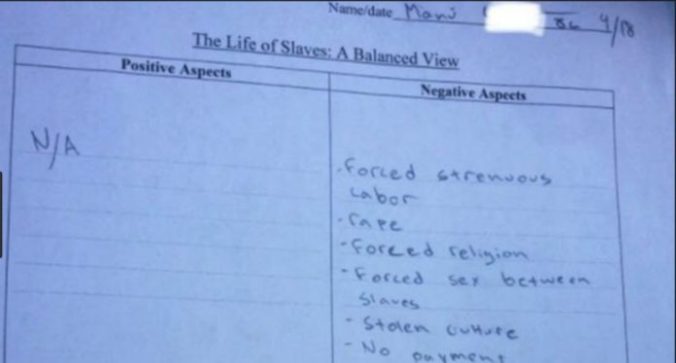
A history teacher at the Great Hearts Monte Vista Charter School (in San Antonio, Texas) distributed an assignment consisting of a worksheet titled “The Life of Slaves: A Balanced View” to eighth graders. The idea was for student to list the positive and negative aspects of slavery. After parent Roberto Livar posted to social media the worksheet his son Manu brought home to complete, the teacher was placed on leave and the school said it would audit the textbook associated with the lesson. Aaron Kindel, the superintendent of Great Hearts Texas, which operates 28 public charter schools in that state and Arizona, said in a statement posted on the Great Hearts Facebook page, “To be clear, there is no debate about slavery. It is immoral and a crime against humanity.” He said the school’s headmaster plans will explain the mistake to the history class.
I can’t wait to hear what that explanation is. How does any American living in the 21st Century not flinch at a title like “The Life of Slaves: A Balanced View”? It sounds like a joke, in fact: there is a whole genre of galley slave cartoons that rely on the idea that there is anything positive about being a slave is inherently ridiculous. (“It’s not a paid position but I’m gaining invaluable experience in the rowing sector!”). Yes, this teacher is incompetent, and leave is too good for him (or her). If you can’t trust a teacher not to hand out something that stupid, what else might be handed out? Hand grenades? “What Happened”?
Sadly, Mr. Livar couldn’t maintain the high ground, and had to say this:
“We are fully aware that there is a concerted effort by the far-right nationally to reframe slavery as being ‘not that bad’ and trying to revise the Civil War as being about ‘states rights’ and not about slavery. We were concerned that this assignment fell in line with that ideology and were naturally concerned, as well as other parents. These issues are not isolated to one school or one book. These issues are systemic and continue up the chain all the way to the Texas School Board of Education.”
He also said this likely happened because the school is short on diversity.
No, it happened because someone mistakenly hired an idiot as a teacher. Continue reading


Good things can even come out of really dumb ethics episodes, like the effort to silence critics of illegal immigration by pointing out that they had legal immigrants in their lineage, a non sequitur if there ever was one.
This good thing is Greg’s Comment of the Day, on Morning Ethics Warm-Up Overstock, 5/15/ 2018: It’s Use Them Or Lose them…: